Financial literacy is defined as the ability to understand and apply money management skills, including budgeting, saving, and responsible credit use, and research proves that building these skills in childhood produces measurably better adult financial outcomes. Why teaching money skills early matters is not a philosophical debate. It is a practical reality backed by data from institutions like the FDIC, PISA, and the TIAA Institute-GFLEC. Financial psychologist Brad Klontz has documented how money attitudes formed before age 10 can follow a person for decades. The earlier children learn to handle money, the more confident and capable they become as adults.
What does research say about the benefits of early financial literacy?
The numbers on adult financial literacy are stark. U.S. adults answered only 49% of financial literacy questions correctly in TIAA Institute-GFLEC surveys, and low-literacy individuals are five times more likely to lack emergency savings. That single statistic explains why so many adults feel anxious about money. They were never taught the basics.
The 2022 PISA assessment adds more weight to this concern. One in five 15-year-olds scored at the lowest level of financial literacy, meaning they could not make basic financial decisions. Only one in ten scored high enough to analyze complex financial products. These are teenagers on the verge of adulthood, and most of them are not ready.
Early financial education changes this trajectory. Research consistently links childhood money lessons to higher rates of budgeting, regular saving, and stronger credit behavior in adulthood. The connection is not coincidental. Children who practice money decisions early build mental frameworks that carry forward.
| Research finding | What it means |
|---|---|
| 49% average score on U.S. financial literacy tests | Most adults lack foundational money knowledge |
| 1 in 5 teens at lowest PISA literacy level | Financial gaps start before adulthood |
| Low literacy = 5x more likely to lack emergency savings | Knowledge gaps create real financial vulnerability |
| Early education links to more frequent budgeting | Childhood habits persist into adult behavior |
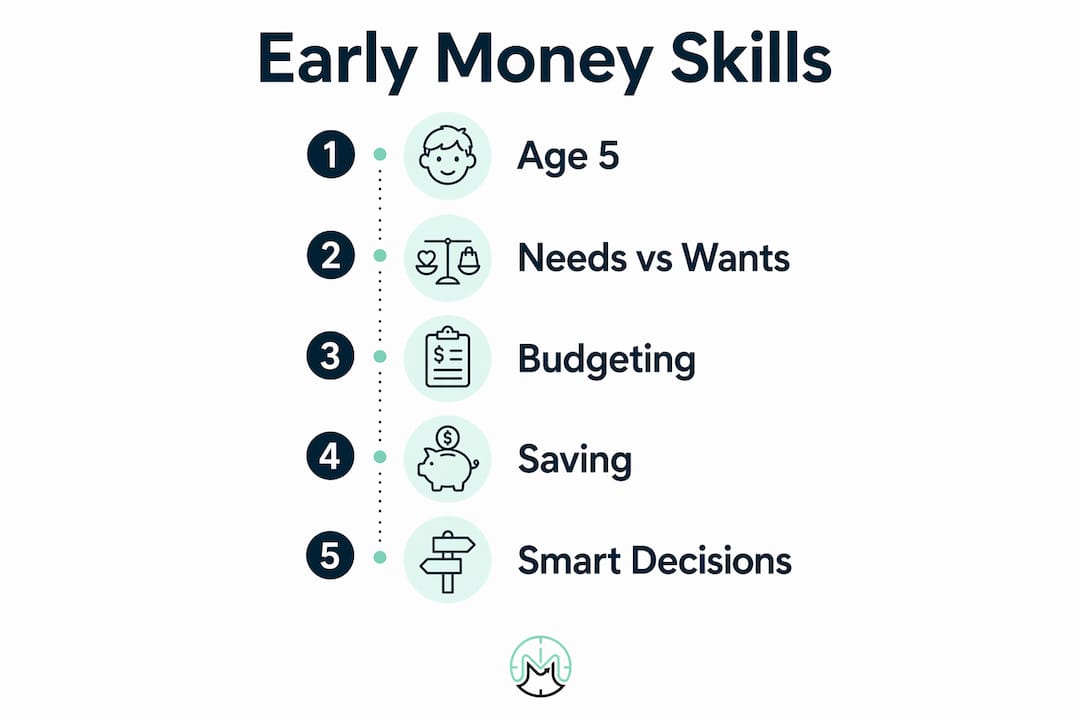
"Financial habit formation starts as early as age 5." Research from financial psychologists confirms that children as young as five can grasp concepts like needs versus wants, and children aged five to seven can handle simple allowances and saving toward a specific goal.
Habit formation begins at age 5, which means the window for building strong money foundations opens far earlier than most parents and educators realize. Waiting until high school to introduce budgeting is like waiting until college to teach reading. The foundation should already be there.
How do attitudes and behavior around money develop in children?

Knowledge alone does not produce good financial behavior. Early financial education produces measurable behavior changes only when attitude and self-efficacy develop alongside facts. A child who knows what a savings account is but feels anxious or powerless about money will not use one consistently. Confidence and positive associations with money matter just as much as definitions.
This is where parental modeling becomes critical. Children observe and replicate their parents' financial behaviors, including credit card use, spending patterns, and saving habits. Inconsistent modeling, such as telling a child to save while visibly overspending, undermines the lesson more effectively than any lack of formal instruction. What you do with money in front of your child teaches more than what you say about it.
One of the most powerful tools for building healthy money attitudes is what researchers call "low-stakes failure." Allowing children to make small financial mistakes with their own allowance, like spending everything on candy and having nothing left for a toy they wanted, teaches opportunity cost more effectively than any lecture. The lesson sticks because the consequence is real, not hypothetical.
Here is what healthy money attitude development looks like in practice:
- Normalize money talk. Parents who avoid financial conversations increase children's anxiety around money, not reduce it. Transparency about household finances builds confidence.
- Praise process, not outcome. Recognize when a child saves toward a goal, not just when they reach it.
- Model intentional spending. Let children see you compare prices, choose store brands, or decide against an impulse purchase.
- Use refusals as teaching moments. Financial psychologist Brad Klontz advises that every time you say "we can't afford that," you can reframe it as "we're choosing to spend our money differently right now."
Pro Tip: When your child asks why you won't buy something, resist the urge to say "we don't have the money." Instead, say "that's not in our budget this week." The second version teaches prioritization. The first teaches scarcity anxiety.
What practical steps can parents and educators take?
Teaching money skills to children works best when it matches where they are developmentally. A five-year-old learning needs versus wants is not the same conversation as a twelve-year-old learning to track spending. The Banco de España's educational framework confirms that games, role-play, and real-life activities boost both retention and real-world application far more than passive instruction.
Here is a practical age-by-age approach:
- Ages 4 to 6. Introduce coins and bills. Play store at home. Teach the difference between needs (food, shelter) and wants (toys, candy). Give a small weekly allowance of one or two dollars to practice making choices.
- Ages 7 to 10. Open a savings account together. Set a savings goal for something the child wants. Involve them in grocery shopping by giving them a small budget for one item and letting them choose. Use money games like Monopoly or The Game of Life to reinforce concepts in a low-pressure setting.
- Ages 11 to 14. Introduce a simple budget. Give a monthly allowance that covers small personal expenses like school snacks or entertainment. Discuss the concept of earning, and consider paid chores for above-and-beyond tasks. Talk openly about financial conversations at home and what the family prioritizes financially.
- Ages 15 and up. Introduce credit, interest, and the basics of investing. Explain how compound interest works using a simple calculator. Discuss the difference between a debit card and a credit card. Encourage part-time work and help them set up a real budget with actual income.
For educators, the same principle applies. Integrating financial literacy programs with local socio-cultural context and peer mentorship components produces the strongest and most sustained results. A classroom lesson on budgeting lands harder when students connect it to something real in their own community.
Pro Tip: Avoid making money a stressful topic at home. Research shows that children whose parents discuss finances openly and calmly develop stronger financial confidence than those raised in households where money is treated as a taboo or source of conflict.
How does early financial literacy prepare kids for today's money world?
Children today face a financial environment that is more complex than any previous generation encountered at the same age. Digital payments, buy-now-pay-later services, subscription billing, and app-based investing tools are all part of normal life before many kids reach high school. Financial literacy today must include digital finance and long-term planning, especially as pension reliance declines and individuals carry more personal responsibility for retirement.
The stakes are higher now than they were a generation ago. A teenager who understands how a credit card's interest rate works is far less likely to carry high-interest debt at 22. A young adult who learned to budget at 12 is more likely to build an emergency fund before a crisis hits.
Here is how early money skills map to modern financial realities:
| Childhood skill | Adult financial outcome |
|---|---|
| Needs vs. wants decisions | Budgeting and spending control |
| Saving toward a goal | Emergency fund and retirement saving |
| Understanding interest | Avoiding high-cost debt |
| Tracking spending | Credit score management |
| Digital payment awareness | Safe use of fintech tools |
Schools and community programs play a real role here. Financial knowledge combined with practical access to credit tools and digital resources produces stronger behavior improvements than classroom theory alone. Programs that include mentorship, peer learning, and hands-on practice consistently outperform lecture-only models. Parents and educators who understand why financial education matters for youth today are better positioned to build the right habits before adulthood arrives.
Key takeaways
Early money skills are the single most reliable predictor of confident, independent adult financial behavior, and the best time to build them is before age 10.
| Point | Details |
|---|---|
| Habits form early | Financial habit formation starts at age 5, making childhood the most effective window for money education. |
| Knowledge needs attitude | Facts alone do not change behavior. Self-efficacy and positive money attitudes must develop alongside knowledge. |
| Parental modeling is powerful | Children replicate what they observe. Consistent, transparent financial behavior at home reinforces every lesson. |
| Age-matched teaching works | Matching money concepts to developmental stages, from allowances at age 5 to budgeting at age 12, builds lasting skills. |
| Modern complexity demands early prep | Digital payments, credit products, and declining pensions make early financial literacy more urgent than ever. |
Build money confidence with Minutementor
You do not need a finance degree to raise a money-smart kid. You need the right tools and five minutes a day.

Minutementor delivers bite-sized financial lessons designed to build real skills fast, whether you are a parent looking to reinforce what your child learns at home or an educator seeking structured, engaging content for your classroom. The platform's AI-powered coach tailors each learning path to specific goals, from budgeting basics to investing fundamentals, so every lesson feels relevant and achievable. Students who use Minutementor report saving thousands and hitting financial milestones they once thought were out of reach. Start building those habits today at Minutementor.
FAQ
Why does teaching money skills early matter so much?
Early money education shapes the financial habits, attitudes, and confidence that follow a person into adulthood. Research shows that low financial literacy makes adults five times more likely to lack emergency savings, a risk that early education directly reduces.
At what age should children start learning about money?
Financial habit formation begins as early as age 5, when children can grasp needs versus wants and practice simple saving. Children aged five to seven can handle small allowances and short-term savings goals with guidance from parents or educators.
What is the most effective way to teach kids about money?
Combining real-life practice with age-appropriate concepts produces the strongest results. Giving children a small allowance, involving them in household budgeting decisions, and using educational money games all outperform passive instruction alone.
Does talking about money stress kids out?
No. Research from financial psychologist Brad Klontz confirms that parental transparency about finances builds children's financial confidence rather than increasing anxiety. Avoiding money talk is what creates stress and uncertainty.
How can educators support financial literacy in the classroom?
Programs that integrate local context, peer learning, and hands-on activities consistently outperform theory-only instruction. Schools that connect financial concepts to students' real lives and include mentorship components see the strongest and most lasting improvements in financial behavior.