Saving money young is the single most powerful financial decision you can make, because time transforms even small amounts into serious wealth through compound interest. The earlier you start, the more your money works for you, and the less you have to contribute overall. This article breaks down the math behind early saving, explains the psychological benefits that come with it, and gives you practical strategies whether you are 16 or 26. Tools like Roth IRAs, 401(k)s, and high-yield savings accounts all work better the sooner you open them.
Why saving money young matters more than saving more later
Compound interest is the process where your money earns returns, and then those returns earn returns on top of themselves. It sounds simple, but the math is staggering over time. The key variable is not how much you save. It is how long your money has to grow.
Starting to invest at 25 instead of 35 with the same monthly contribution and a 7% annual return results in roughly $426,000 more by age 65. That gap exists even though both people contributed the same total amount. The only difference is a single decade of compounding time.

The first dollars you invest are your most valuable. They have the longest runway to grow. A dollar invested at 22 has more than 40 years to compound before a typical retirement age. A dollar invested at 42 has fewer than 20. That is not a small difference. It is the difference between financial freedom and financial stress.
Here is a concrete comparison of what compounding looks like over time, assuming a 7% annual return:
| Starting age | Monthly contribution | Total contributed by 65 | Estimated balance at 65 |
|---|---|---|---|
| 22 | $200 | $103,200 | ~$525,000 |
| 25 | $200 | $96,000 | ~$480,000 |
| 35 | $200 | $72,000 | ~$240,000 |
| 45 | $200 | $48,000 | ~$95,000 |
The person who starts at 22 contributes only about twice as much as the person who starts at 45, but ends up with more than five times the money. That is compound interest doing the heavy lifting.
Pro Tip: Start investing even before you have a full emergency fund. Parallel saving and investing in your 20s beats waiting until everything feels perfect.
What are the psychological benefits of saving money young?
The benefits of saving young go far beyond your bank balance. Building a saving habit early changes how you think about money, work, and risk. That shift is worth just as much as the dollars themselves.
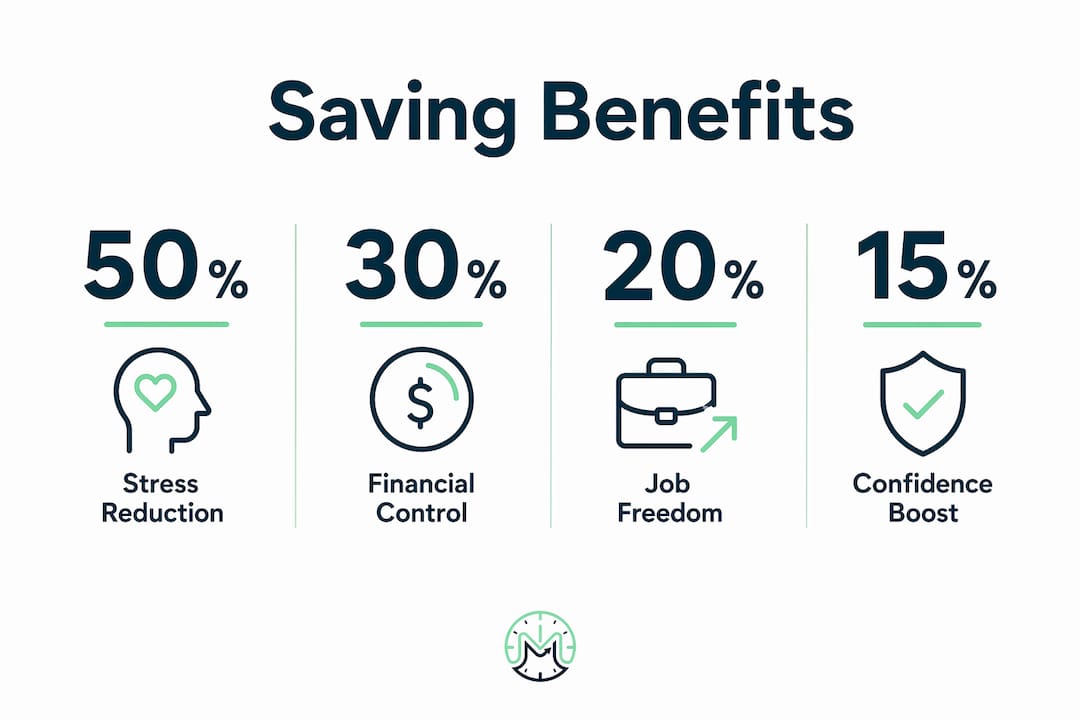
Emergency savings function as "option funds" that give you real power over your life. When you have money set aside, you can leave a bad job, say no to a toxic situation, or take a career risk without panicking. That kind of freedom is not something you can buy later. You build it by saving consistently now.
People who save regularly face less pressure to accept unfavorable job situations or take on high-interest debt. Saving gives you options. It reduces the anxiety that comes from living paycheck to paycheck and puts you in control of your own decisions.
There is also the "comparison tax" to watch out for. Social media pressure to match lavish lifestyles is one of the biggest psychological barriers to saving among young people. Seeing friends spend on travel, clothes, and restaurants creates a pull to do the same, even when it hurts your finances. Recognizing this pressure by name helps you resist it.
Here are the core psychological wins that come with building a saving habit early:
- Less anxiety. Knowing you have a financial cushion reduces daily stress about unexpected costs.
- More confidence. Watching your savings grow builds real self-trust around money decisions.
- Greater career freedom. Savings let you take risks, like switching jobs or starting a side project, without fear.
- Reduced debt dependency. When you have savings, you borrow less and avoid high-interest traps.
- Better spending awareness. Saving regularly forces you to notice where your money actually goes.
Pro Tip: Automate a 1% salary increase in your savings contribution each year. You will barely notice it in your monthly budget, but it compounds dramatically over decades.
How do saving goals differ for teenagers vs. young adults?
Teenagers and young adults face different financial realities, so their saving strategies should look different too. The right approach depends on your age, income, and what you are saving for.
For teenagers, the goal is to build the habit and start small. Even saving $25 a month from a part-time job builds discipline and creates a foundation. Opening a basic savings account at a bank like Chase, Ally, or a local credit union is a practical first step. Learning age-appropriate money skills early makes every future financial decision easier.
For young adults in their 20s, the priority shifts to tax-advantaged accounts and employer benefits. A 401(k) with an employer match is free money. Not contributing enough to get the full match is one of the most common and costly mistakes young workers make. A Roth IRA is another powerful tool because contributions grow tax-free, and withdrawals in retirement are not taxed either.
Here is a side-by-side look at saving priorities by age group:
| Age group | Primary goal | Best tools | Key action |
|---|---|---|---|
| Teenagers (13–19) | Build the habit | Savings account, piggy bank | Save a fixed percentage of every dollar earned |
| Early 20s | Emergency fund + investing | High-yield savings, Roth IRA | Open a Roth IRA and automate contributions |
| Mid-to-late 20s | Long-term wealth building | 401(k), index funds, Roth IRA | Max employer match, increase contributions annually |
A few practical steps that apply to both groups:
- Set a specific savings goal, like three months of expenses in an emergency fund.
- Automate transfers so saving happens before you can spend the money.
- If you have student loans, balance loan repayment and saving at the same time rather than waiting until debt is gone.
- Start with any amount. $10 a week is $520 a year, and that is a real start.
Social Security replaces only about 40% of pre-retirement earnings, which means personal savings are not optional. They are the foundation of any real retirement plan.
What stops young people from saving, and how do you fix it?
Most young people know they should save. The problem is not information. It is the barriers that get in the way. Understanding those barriers is the first step to getting past them.
The biggest myth is that you need a high salary before you can start. Waiting for a "perfect salary" is a costly mistake that costs hundreds of thousands in lost compound growth. The math does not care about your income level. It cares about how early you start.
Social media makes this worse. Watching peers spend freely creates the illusion that everyone else can afford it. Most of them cannot. The comparison trap is real, and it is expensive. Financial planners call this the comparison tax on youth saving, and it is one of the most common reasons young people delay building savings.
Here is how to push through the most common barriers:
- Barrier: "I don't earn enough." Fix: Start with $5 or $10 a week. The habit matters more than the amount right now.
- Barrier: "I'll start when I get a raise." Fix: Set a calendar reminder to open a savings account today. Do not wait for a trigger that may never come.
- Barrier: "Investing feels complicated." Fix: Use index funds through platforms like Fidelity or Vanguard. They require no expertise and have low fees.
- Barrier: "I have debt to pay off first." Fix: Pay minimums on debt while saving a small amount in parallel. Stopping saving entirely costs you compounding time you cannot get back.
- Barrier: "I'll forget to transfer money." Fix: Automate it. Set up a recurring transfer the day after your paycheck lands.
Building smart money habits early removes the need for willpower. Automation and small consistent actions beat big sporadic ones every time. Financial literacy for youth is the foundation that makes all of these habits stick.
Start building your financial future with Minutementor
Knowing why saving matters is step one. Building the actual skills to do it consistently is step two. That is where Minutementor comes in.

Minutementor delivers five-minute daily money lessons built specifically for students and young professionals. The platform's AI-powered coach creates a personalized learning path based on your goals, whether that is budgeting, investing, or getting out of debt. You can finish a lesson on your commute, track your progress, and level up your financial knowledge one day at a time. Students on the platform have reported saving thousands and hitting real financial milestones. If you are ready to turn what you just learned into a daily habit, Minutementor is the place to start.
Key takeaways
Starting to save young is the highest-return financial decision available to you, because compound interest multiplies early contributions far beyond what late saving can match.
| Point | Details |
|---|---|
| Time beats income | Starting at 25 instead of 35 can mean $426,000 more by retirement, even with identical contributions. |
| Compound interest is exponential | Early dollars grow the most because they have the longest runway to compound. |
| Savings create life freedom | An emergency fund acts as an "option fund," giving you power to leave bad jobs and take career risks. |
| Small amounts work | Even $10 a week builds the habit and starts compounding. Amount matters less than starting date. |
| Automation removes barriers | Automating savings and annual contribution increases builds wealth without relying on willpower. |
FAQ
How much should a teenager save each month?
Any consistent amount builds the habit that matters most. Starting with 10–20% of any income you earn, even from a part-time job, is a solid target.
What is compound interest in simple terms?
Compound interest means your savings earn returns, and then those returns earn returns on top of themselves. The longer your money sits, the faster it grows.
Is a Roth IRA better than a regular savings account for young adults?
A Roth IRA grows tax-free and is one of the best long-term tools for young adults. A regular savings account is better for short-term goals and emergency funds. Use both.
What if I have student loans? Should I still save?
Yes. Saving in parallel with loan repayment preserves your compounding time. Pausing all saving until debt is gone costs you years of growth you cannot recover.
Why does starting 10 years earlier make such a big difference?
Because compound interest is exponential, not linear. Each additional year of growth multiplies your entire balance, not just new contributions. A decade of extra compounding creates a gap that larger contributions later cannot close.