Money mistakes are learning tools, not failures. Every overdraft, bad investment, or impulse purchase is a direct feedback signal that no textbook can replicate. Financial educators like David Meltzer and Francis J. Kong, along with research from Psychology Today, confirm that errors create the exact mental conditions needed for lasting behavior change. The key is knowing how to capture, test, and apply what each mistake teaches you.
Why money mistakes are learning tools worth documenting
The fastest way to turn a financial error into lasting wisdom is to write it down within 24 hours. Documenting a mistake quickly captures the facts and feelings before your ego rewrites the story. Delay even a few days, and your brain starts filling gaps with self-justification instead of honest analysis.
Here is exactly what to record when a money mistake happens:
- What happened: The specific event, date, and dollar amount involved
- What you believed: The assumption or expectation that led to the decision
- What the data showed: The actual result versus what you predicted
- The rule going forward: One simple, measurable behavior to change next time
This four-part format, drawn from David Meltzer's framework, strips the emotion out of the event and turns it into a usable lesson. You stop asking "Why am I so bad with money?" and start asking "What rule do I need to follow differently?"
Shame is the biggest enemy of financial learning. Sharing lessons openly reduces that shame and builds trust, whether you share with a friend, a mentor, or a financial community. Transparency converts a private embarrassment into a public asset.
Pro Tip: Set a phone alarm labeled "Money Mistake Log" for the evening after any financial decision that stings. Five minutes of honest notes right then will save you from repeating the same error six months later.
How does a 30-day review cycle validate financial lessons?
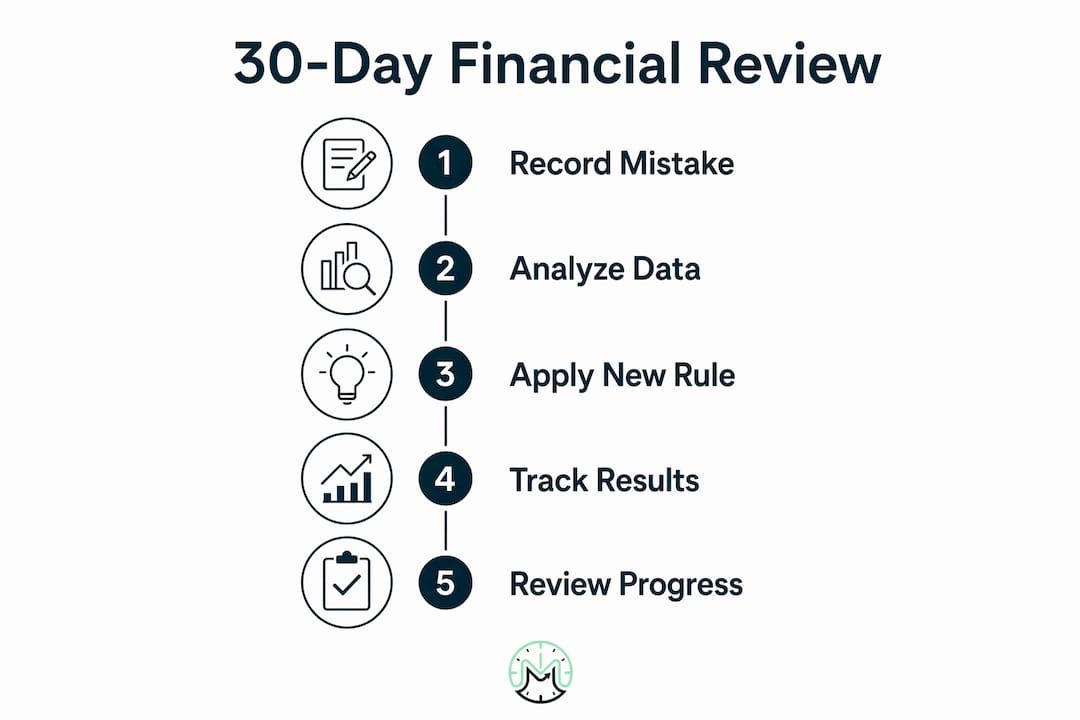
Writing down a lesson is only half the work. You need to test whether that lesson actually changes your behavior. A structured 30-day review cycle gives you a clear window to find out.
Here is how to run one:
- Define the lesson as a rule. Turn your mistake into a specific behavior. "I will not buy anything over $50 without waiting 48 hours" is testable. "I need to be smarter with money" is not.
- Set a measurable metric. Track one number: impulse purchases per week, credit card balance, or savings rate. Pick the metric that directly reflects the lesson you are testing.
- Check in at day 15. A midpoint review catches drift early. If you have already broken the rule three times, adjust the rule rather than abandoning it.
- Evaluate at day 30. If no measurable improvement occurs within 30 days, the lesson was not effectively integrated. That is not a failure. It means you need a different rule or a smaller first step.
- Lock in what works. When the metric improves, formalize the rule as a permanent habit. Add it to your budget or spending guidelines.
This iterative approach treats your financial life like a series of small experiments rather than a single high-stakes test. You learn from money blunders without betting everything on one change at once.
Pro Tip: Use a free tool like Google Sheets or the Notes app on your phone to track your 30-day metric. A simple table with date, rule followed (yes or no), and one observation per day takes less than two minutes and creates a clear record of progress.
What is the mistake fund and how does it build judgment?
The Mistake Fund is a small, pre-set pool of money you designate specifically for financial decisions that carry real risk. This controlled approach lets you build judgment through lived experience without threatening your savings, rent, or long-term goals.

Think of it as a practice court. You make real decisions with real money, but the stakes are capped. The loss stings enough to teach you something. It does not wipe you out.
| Feature | Mistake Fund | Uncontrolled Risk-Taking |
|---|---|---|
| Amount at risk | Fixed, small, pre-decided | Unlimited, often emotional |
| Learning outcome | Clear lesson from a bounded loss | Lesson buried under financial stress |
| Emotional response | Manageable discomfort | Panic, shame, or denial |
| Long-term impact | Builds discipline and patience | Often triggers avoidance of investing |
| Best for | Beginners, students, young adults | Nobody. Guardrails always help. |
The Mistake Fund works for adults and kids alike. A teenager given $50 to invest or spend freely will learn more about risk, patience, and judgment than one who reads ten chapters on the subject. Holding a small fund for tactical mistakes teaches risk management without compromising long-term capital.
The guardrail is the point. You are not trying to win with the Mistake Fund. You are trying to feel the feedback loop of a real financial decision so your brain encodes the lesson properly.
What psychological barriers block learning from financial errors?
The biggest obstacle to learning from money mistakes is not the mistake itself. It is the story you tell yourself about what the mistake means. Francis J. Kong identifies identity attachment to outcomes as the core barrier. When you treat a financial loss as proof that you are bad with money, you stop analyzing the decision and start defending your self-image.
Here are the most common psychological barriers and how to break through each one:
- Identity fusion: You believe the loss reflects your worth as a person. Fix this by labeling mistakes as system failures, not character flaws. "My budgeting system failed" is solvable. "I am irresponsible" is paralyzing.
- Perfectionism: You delay financial decisions because any possible mistake feels unacceptable. David Meltzer's research is direct: the market rewards speed of learning, not perfection. Waiting for a risk-free moment means waiting forever.
- Shame spirals: One bad decision triggers avoidance of all financial thinking. You stop checking your bank account, skip budget reviews, and fall further behind. Neuroscience research from Psychology Today shows that glaring errors trigger optimal brain learning states by briefly opening a high-performance learning window. The brain is literally primed to grow right after a mistake. Avoidance wastes that window.
- Comparison traps: You measure your financial errors against other people's highlight reels. This produces shame without data. Compare your current behavior to your past behavior instead.
The reframe that works is treating mistakes as data points rather than moral verdicts. A data point tells you something useful. A moral verdict just makes you feel stuck.
How to build daily habits that lock in financial lessons
Learning from a money mistake once is not enough. The goal is to build habits that make the lesson automatic. These steps create a repeatable system for turning financial learning experiences into lasting behavior change.
- Run small tests before big commitments. Before changing your entire budget, test one new rule for two weeks. Small, inexpensive experiments reduce the risk of large failures and give you clear feedback on what actually works for your situation.
- Keep a money journal. Write one sentence per day about a financial decision you made. Over 30 days, patterns emerge. You will spot triggers, habits, and blind spots you never noticed before.
- Find one accountability partner. Share your current financial rule with a trusted friend or peer. You do not need to share dollar amounts. Just share the rule and check in weekly. External accountability doubles follow-through rates in behavior change research.
- Set spending guardrails. Cap discretionary categories in your budget before the month starts. A guardrail removes the decision in the moment, which is when willpower is lowest. Check out money games and skill-building tools to make this practice more engaging.
- Schedule a weekly five-minute review. Every Sunday evening, ask three questions: What financial decision did I make this week? Did it follow my current rule? What do I adjust for next week? Five minutes of honest reflection compounds over time.
Pro Tip: Pair your weekly review with something you already do, like making coffee or charging your phone for the night. Habit stacking makes the review automatic instead of optional.
Key takeaways
Money mistakes are the most direct form of financial education available, and a structured approach to documenting, testing, and reflecting on them builds lasting money management skills faster than theory alone.
| Point | Details |
|---|---|
| Document within 24 hours | Record the event, belief, data, and a new rule before ego distorts the facts. |
| Test lessons for 30 days | Measure one specific behavior change and adjust if no improvement appears by day 30. |
| Use a Mistake Fund | Set aside a small, fixed amount for risky decisions to learn without threatening core finances. |
| Separate identity from outcome | Label errors as system failures, not character flaws, to stay objective and keep learning. |
| Build daily review habits | A five-minute weekly check-in compounds financial self-awareness faster than any single lesson. |
Turn your money mistakes into your biggest asset with Minutementor
Every financial setback you have experienced holds a lesson worth more than the money you lost. Minutementor is built for exactly this moment. The platform delivers five-minute daily lessons that match where you are right now, whether you are recovering from debt, rebuilding a budget, or learning to invest for the first time.
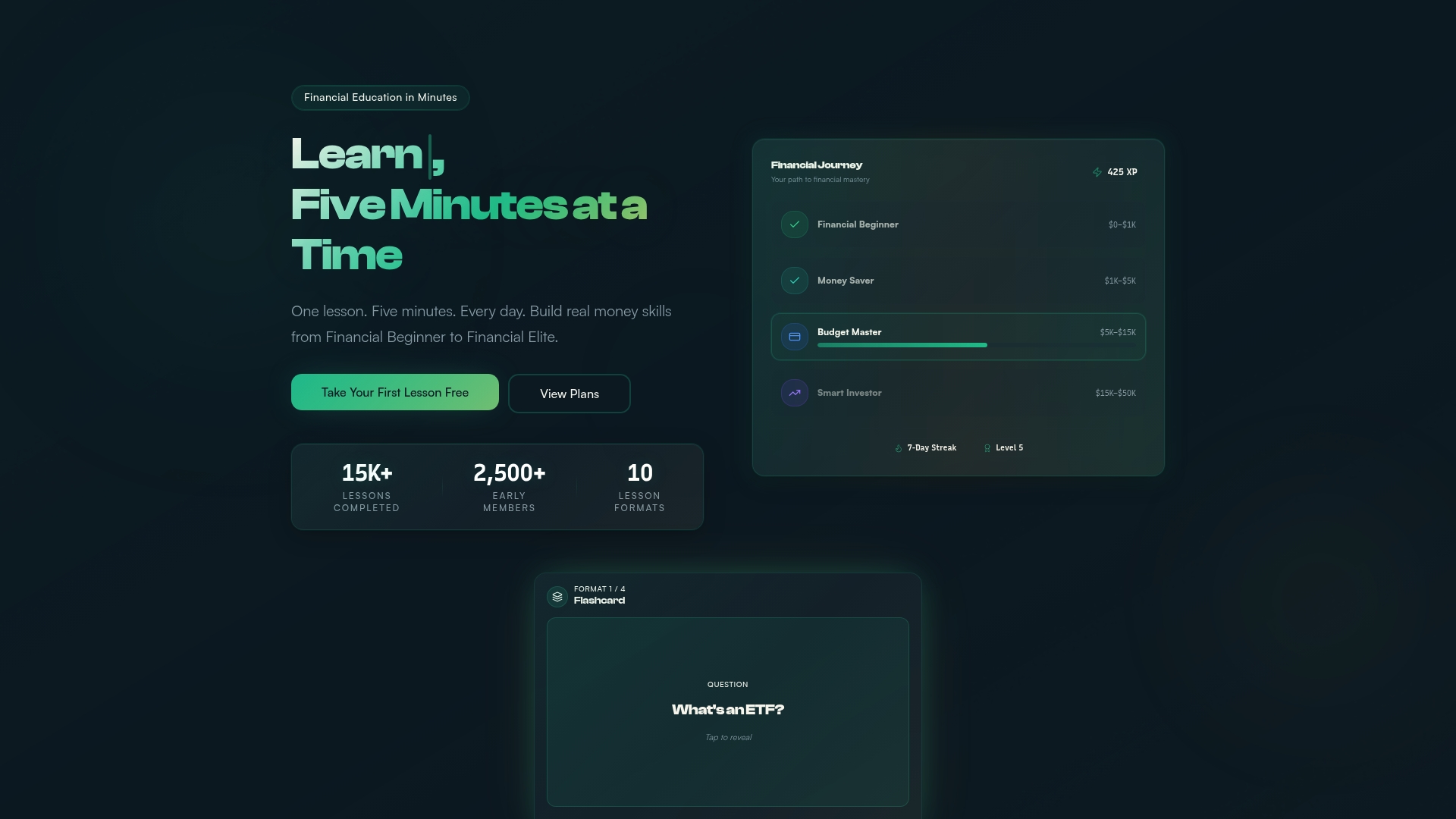
Minutementor's AI-powered coach builds a personalized learning path based on your specific goals, so you are not sitting through generic advice. You get targeted lessons on budgeting, debt management, and investing that connect directly to the money management lessons you are already living. Progress tracking and gamified milestones keep you moving forward, even on the days when money feels overwhelming. Start building your financial skills today and turn what went wrong into what goes right next.
FAQ
What makes money mistakes valuable for financial learning?
Money mistakes create direct feedback that abstract lessons cannot replicate. Errors trigger optimal brain learning states, opening a window for high-performance skill development that makes the lesson stick.
How soon should you document a financial mistake?
Document within 24 hours. Waiting longer allows ego to distort the facts, which reduces the quality of the lesson you extract from the experience.
What is the mistake fund?
The Mistake Fund is a small, pre-set pool of money designated for financial decisions that carry real risk. It builds judgment and discipline through lived experience without threatening your core savings or long-term goals.
How do you stop shame from blocking financial growth?
Treat mistakes as system failures rather than personal moral failures. Seeing errors as data points, as recommended by financial educators like Francis J. Kong, keeps your analysis objective and your motivation intact.
How long should you test a financial lesson before moving on?
Run a 30-day test with one measurable metric. If no clear improvement appears, revise the rule rather than abandoning the effort entirely.