Extra loan payments reduce your principal balance faster, which directly cuts the total interest you pay and shortens your loan term. This is the core mechanic behind what financial professionals call loan prepayment, and understanding it can save you thousands of dollars. The impact of extra loan payments compounds over time because interest accrues on your remaining balance. The earlier you pay down that balance, the less interest builds up. This guide breaks down why extra loan payments matter, how they work, and how to use them wisely in your personal financial plan.
Why extra loan payments matter: the math behind the savings
Extra payments work because of how amortization functions. Amortization is the process of spreading loan payments across a fixed schedule, where each payment covers both interest and principal. Early in the loan, most of your payment goes toward interest. Only a small slice reduces the actual balance you owe.
When you make an extra payment and direct it to principal, you shrink that balance immediately. A smaller balance means less interest accrues next month. That creates a chain reaction: less interest means more of your regular payment goes to principal, which shrinks the balance even faster. Extra payments impact amortization exponentially, not linearly, which is why early action matters so much.

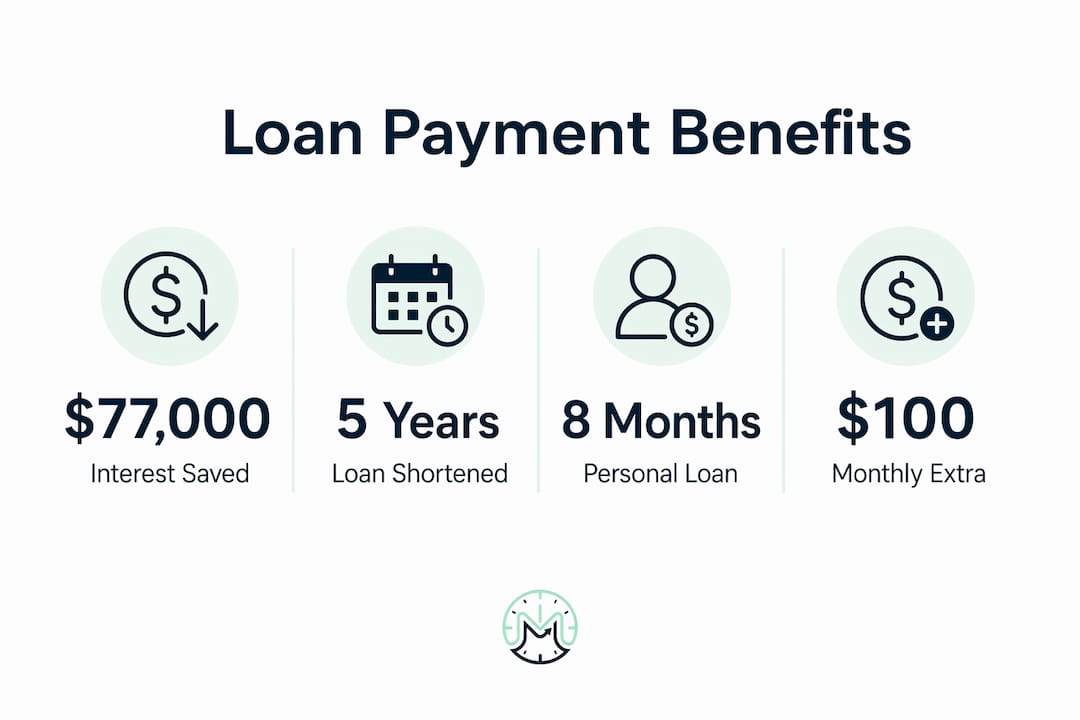
Here is a concrete example. On a $15,000 personal loan at 12.26% APR, adding $100 monthly shortens the loan by 8 months and saves about $847 in interest. That is an ROI of 141%, meaning for every extra dollar you pay, you avoid $1.41 in future interest. The numbers get even bigger on a mortgage.
Making one extra mortgage payment per year can shorten a 30-year loan by over five years and save more than $77,000 in interest. That single annual payment has an outsized effect because it hits the principal at a point when the amortization schedule still has decades of interest ahead of it.
| Scenario | Extra Payment | Interest Saved | Loan Shortened By |
|---|---|---|---|
| $15,000 personal loan at 12.26% APR | $100/month | ~$847 | 8 months |
| 30-year mortgage | 1 extra payment/year | $77,000+ | 5+ years |
Pro Tip: Always confirm with your loan servicer that extra payments are applied to principal, not toward your next scheduled payment. A misapplied payment saves you nothing.
What are the benefits of extra payments beyond interest savings?
Saving on interest is the headline benefit, but the advantages go further. Paying down your loan faster improves your financial profile in several concrete ways.
- Lower debt-to-income ratio. Your debt-to-income (DTI) ratio measures how much of your monthly income goes toward debt payments. Faster principal paydown lowers your DTI, which makes you more attractive to lenders when you apply for a car loan, credit card, or new mortgage.
- Better credit score. Reducing your outstanding loan balance improves your credit utilization and overall credit profile. A stronger credit score opens doors to lower interest rates on future borrowing.
- Faster home equity. For mortgage holders, every extra dollar paid to principal builds equity. More equity means a higher net worth and more borrowing power through a home equity line of credit.
- PMI removal. Private mortgage insurance (PMI) is required when your home equity falls below 20%. Paying down your mortgage faster gets you past that threshold sooner, eliminating a monthly cost that adds nothing to your net worth.
- Psychological relief. Watching your balance drop faster is genuinely motivating. Debt carries mental weight, and reducing it ahead of schedule gives you a real sense of progress and control.
The psychological dimension is not trivial. Financial research supports the idea that visible progress keeps people on track. Seeing your loan balance shrink faster than the standard schedule reinforces the habit of making extra payments.
Pro Tip: Before putting every spare dollar toward your loan, check whether you have high-interest credit card debt. Paying off a 20% APR card first delivers a higher guaranteed return than prepaying a 6% mortgage.
When and how should you make extra loan payments?
Timing is the single biggest variable in how much you save. Applying extra payments early in the loan term is up to 10 times more effective than applying the same amount later. That is because early payments reduce a balance that still has years of interest ahead of it. A $500 extra payment in year one of a 30-year mortgage saves far more than a $500 extra payment in year 25.
Lump sum vs. monthly extra payments
Both approaches work. They just work differently.
Lump-sum payments maximize mathematical interest savings because a large chunk of principal disappears at once. Monthly extra payments offer more flexibility and are easier to budget for. From a behavioral standpoint, monthly extras tend to produce better long-term adherence because they fit into a regular routine without requiring a windfall.
The right choice depends on your cash flow. If you receive an annual bonus or tax refund, a lump sum applied directly to principal is a powerful move. If your income is steady but not flush, adding a fixed amount each month is more realistic and still highly effective.
Common pitfalls to avoid
- Not specifying principal application. Loan servicers often apply extra funds toward your next scheduled payment by default. That does not reduce your balance faster. Always write "apply to principal" in the memo or contact your servicer directly.
- Ignoring prepayment penalties. Some loans, particularly certain personal loans and older mortgages, include prepayment penalty clauses. Read your loan agreement before making large extra payments.
- Paying extra on low-rate debt while carrying high-rate debt. Higher interest rate loans yield a higher ROI on extra payments, with returns ranging from 80% to 200% depending on APR and loan term. Prioritize accordingly.
- Depleting your cash reserves. Extra loan payments lock in funds. Once paid, that money is not accessible in an emergency without refinancing or borrowing again.
How to decide if extra loan payments fit your financial plan
Extra payments are not the right move for everyone at every moment. The decision depends on your full financial picture, not just your loan balance.
Financial experts recommend ensuring emergency savings and retirement contributions are in place before committing to extra loan payments. Funds applied to a loan are not easily accessible. If your emergency fund covers less than three months of expenses, building that cushion first is the smarter move.
Ask yourself these questions before committing to a prepayment strategy:
- Do I have three to six months of living expenses saved in an accessible account?
- Am I contributing enough to my 401(k) or IRA to capture any employer match?
- Do I carry any high-interest debt, such as credit cards, that should be paid first?
- Does my loan have a prepayment penalty that would reduce my savings?
- Will making extra payments leave me with enough monthly cash flow to cover unexpected costs?
If you answer yes to the first two and no to the last three, extra loan payments are likely a strong fit. The snowball method targets smallest balances first for psychological wins, while the avalanche method targets highest-interest debt first for maximum mathematical savings. Both are valid. The best method is the one you actually stick with.
Balancing loan repayment with saving is a skill, not a formula. A good starting point is the loan repayment and saving guide that walks through how to allocate extra cash across competing financial priorities. The goal is not to pay off debt as fast as possible at all costs. The goal is to build lasting financial strength.
Minutementor makes loan strategy simple
Knowing why extra loan payments matter is step one. Putting that knowledge into a real plan is where most people get stuck.
Minutementor delivers five-minute daily lessons on debt management, budgeting, and building credit, all tailored to your specific goals by an AI-powered personal finance coach. Whether you are managing a student loan, a personal loan, or a mortgage, the platform builds a learning path around your situation. You get interactive lessons, progress tracking, and the kind of clear explanations that make financial decisions feel less intimidating. Build your money skills with Minutementor and start making every dollar work harder.
Key takeaways
Extra loan payments reduce principal faster, which cuts total interest paid and shortens your loan term through the exponential mechanics of amortization.
| Point | Details |
|---|---|
| Early payments save the most | Applying extra payments early can be up to 10 times more effective than the same amount paid later. |
| Specify principal application | Always instruct your servicer to apply extra funds to principal, not your next scheduled payment. |
| Benefits go beyond interest | Extra payments lower your DTI ratio, build equity, and can eliminate PMI on a mortgage. |
| Prioritize high-rate debt first | Loans with higher APRs deliver the greatest ROI on extra payments, ranging from 80% to 200%. |
| Build savings before prepaying | Secure your emergency fund and retirement contributions before committing extra cash to loan payoff. |
FAQ
How much can one extra mortgage payment per year save?
Making one extra mortgage payment per year can shorten a 30-year loan by over five years and save more than $77,000 in interest. The exact savings depend on your loan balance, interest rate, and how early in the term you start.
Do extra loan payments always reduce interest?
Extra payments reduce interest only when applied directly to principal. If your servicer applies the extra funds toward your next scheduled payment instead, your balance does not drop and no interest is saved.
Is it better to make monthly extra payments or a lump sum?
Lump-sum payments save more interest mathematically because they reduce the principal in one move. Monthly extra payments offer more flexibility and tend to be easier to maintain consistently over time.
Should I pay extra on my loan before building an emergency fund?
Financial experts recommend building an emergency fund of three to six months of expenses before making extra loan payments. Funds paid toward a loan are not easily accessible if an unexpected cost arises.
What is the best loan to target with extra payments first?
Target the loan with the highest interest rate first. Higher APR loans generate more interest each month, so extra payments on those loans deliver the greatest return, up to 200% ROI depending on the rate and term.