Game-based financial education is the practice of using structured play to teach money management skills through active decision-making rather than passive instruction. When you use games to teach budgeting, abstract concepts like trade-offs, saving, and spending limits become concrete choices kids make in real time. Research confirms that games shift budgeting education from passive lecture to active negotiation of financial choices. That shift matters because children retain lessons far better when they experience consequences firsthand. This guide gives educators and parents a practical framework for selecting, running, and debriefing budgeting games across every age group.
How to use games to teach budgeting at every age
Financial literacy games are not one-size-fits-all. The right game depends entirely on where a child is developmentally, and mismatching complexity to age is the fastest way to lose engagement.
Age-appropriate game selection follows a clear progression:
- Ages 3–6: Focus on coin identification, sorting, and the basic concept of needs versus wants. Simple physical activities, like sorting toy coins into labeled jars, build number recognition and the idea that money is finite.
- Ages 7–12: Introduce allowance mechanics, savings goals, and basic trade-offs. Board games that simulate earning and spending work well here. Children at this stage can grasp the idea that spending on one thing means less for another.
- Ages 13–17: Move into complex budgeting simulations involving credit scores, taxes, and emergency expenses. Teens can handle scenarios like managing a $300 monthly income, paying simulated rent, and responding to unexpected car repairs.
Game formats matter as much as content. Board games work well for family settings and small classrooms because they require no technology and generate natural conversation. Digital apps suit independent practice and allow teens to replay scenarios quickly. Role-playing simulations, where students act as renters, employees, or small business owners, are the most immersive format and produce the richest post-game discussions.
For a detailed breakdown of what financial skills to target at each stage, the age-appropriate money lessons guide from Minutementor maps specific concepts to developmental readiness.

Pro Tip: If you are unsure whether a game is age-appropriate, play one round yourself first. You will immediately spot whether the vocabulary, math, or scenario complexity fits your students or children.
How do you choose the right budgeting game for your lesson?
Choosing the wrong game wastes time and frustrates learners. Three factors determine whether a game fits your lesson: time requirements, technical needs, and learning goals.
| Game type | Duration | Complexity | Best setting |
|---|---|---|---|
| Coin sorting activity | 15–20 minutes | Low | Home, early grades |
| Allowance board game | 30–45 minutes | Low to medium | Family, grades 2–5 |
| Budgeting card game | 30–60 minutes | Medium | Classroom, grades 4–8 |
| Digital budgeting app | 20–40 minutes | Medium | Independent or lab setting |
| Full financial simulation | Up to 6 hours | High | High school, university, nonprofits |
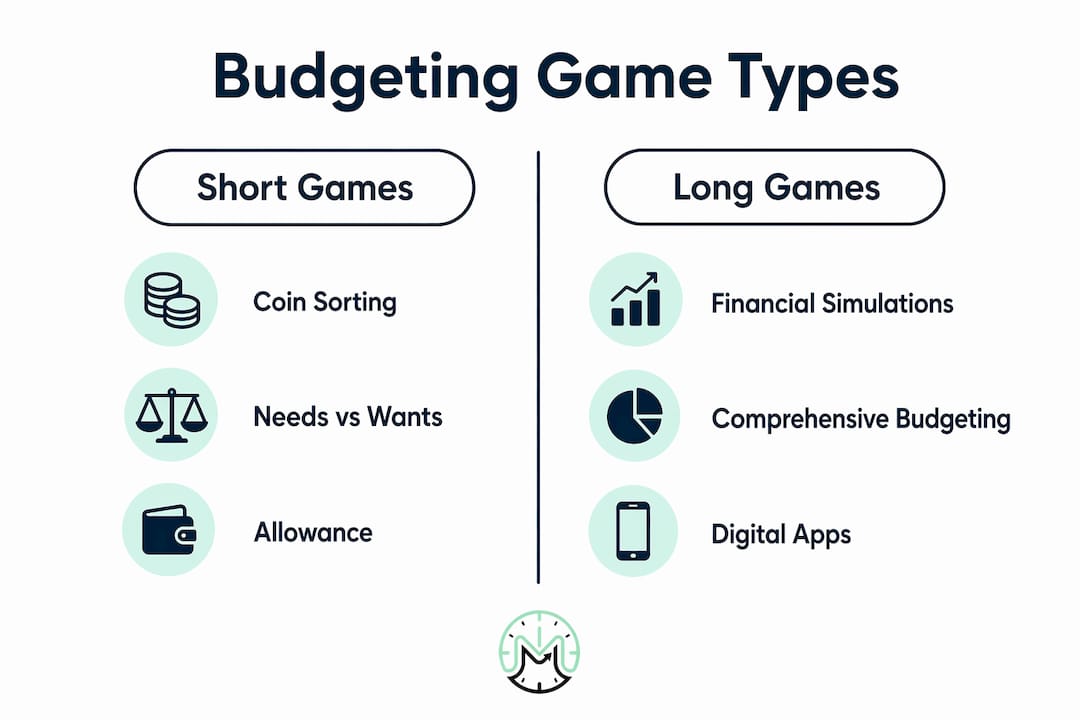
Financial simulations vary widely in duration, from short modular games that fit a 15–30 minute window to comprehensive simulations covering loans and insurance that can span up to 6 hours. That range means you must match the game to your available time before you commit to it.
Technical needs are easy to overlook. A digital game that requires app downloads, Wi-Fi, or device compatibility can derail a classroom lesson before it starts. Always test the setup the day before. For home use, confirm that the game runs on the device your child actually has access to.
Learning goals should drive every selection decision. If your goal is teaching the difference between needs and wants, a simple card-sorting game beats a full simulation. If your goal is showing a teenager how credit card interest compounds, a simulation that tracks debt over multiple rounds is the right tool. Use the money games educational checklist from Minutementor to evaluate any game against your specific objectives before bringing it into a lesson.
Pro Tip: Reserve at least 20% of your total game time for debriefing. A 45-minute game needs at least 10 minutes of structured discussion afterward to convert play into lasting learning.
Step-by-step strategies for integrating budgeting games into lessons
Running a budgeting game well is not just about pressing play. The structure around the game determines whether students walk away with real skills or just a fun memory.
-
State the learning objective before the game starts. Tell students exactly what financial concept the game teaches. "Today we are practicing how to prioritize spending when money runs out" is more effective than "we are playing a money game." Clear objectives focus attention on the lesson, not just the competition.
-
Explain the rules completely, then run a practice round. Confusion about mechanics pulls attention away from financial concepts. A short practice round lets students ask questions in a low-stakes moment before real decisions begin.
-
Create a safe environment for trial and error. Students retain financial lessons better in gaming environments where they can make errors without real consequences. Remind students explicitly that losing money in the game is part of the learning, not a failure.
-
Use the three-jar system as a physical anchor. The three-jar method splits money into spending, saving, and giving using a 60/30/10 ratio. Pairing this physical activity with a game gives younger children a tangible model they can reference during play.
-
Pause the game at key decision points. When a student faces a major choice, like whether to spend their last $50 on entertainment or save it for an emergency, pause and ask the group what they would do. These moments generate the most authentic financial conversations.
-
Run multiple playthroughs when time allows. Multiple playthroughs reinforce lessons by letting students apply what they learned from their first round of mistakes. The second run almost always produces better decisions and deeper understanding.
-
Close with a structured debrief. Ask three questions: What happened? Why did it happen? What would you do differently with real money? These questions connect game mechanics to personal finance in a way that sticks.
For more ideas on pairing games with everyday money habits, the chores and money lessons guide from Minutementor offers practical activities that complement game-based learning at home.
What are the most common challenges with budgeting games?
Even well-chosen games can fall flat. Knowing the common failure points helps you fix them before they derail the lesson.
- Overemphasis on winning. When students focus only on beating each other, the financial concepts disappear. Reframe success before the game starts. The winner is not the richest player. The winner is the player who makes the most thoughtful decisions.
- Disengagement from older students. Teens disengage when a game feels childish or irrelevant. Choose simulations that mirror real adult scenarios, like managing rent, groceries, and a car payment on a $1,500 monthly budget.
- Confusion over money concepts. If students do not understand interest, taxes, or credit before the game, they will make random decisions rather than informed ones. Spend five minutes on a concept explanation before gameplay begins.
- Skipping the debrief. This is the single most common mistake. Structured debriefing after gameplay is what connects game mechanics to real-world finances. Without it, the session is entertainment, not education.
- Misaligned game choice. A game designed for 12-year-olds will not challenge a 16-year-old. A simulation built for teens will overwhelm a 7-year-old. Age alignment is not optional.
"Games act as proxies for complex financial environments in a safe context, stimulating money conversations kids might not have otherwise." — Experian financial education research
The deeper principle here is that safe failure conditions empower students to experiment without fear. That confidence carries directly into real financial decisions. A teenager who has already navigated a simulated credit crisis is far less likely to panic when facing a real one.
Minutementor makes game-based financial learning stick
Budgeting games build great instincts. Minutementor builds the knowledge that makes those instincts reliable.

Minutementor delivers five-minute daily lessons on budgeting, saving, and money management through an AI-powered learning path tailored to each student's goals. For educators and parents, Minutementor works as the perfect complement to game-based sessions. Use a game to spark the conversation, then use Minutementor to reinforce the concept the same day. Students who combine hands-on play with structured micro-lessons build financial confidence faster than either method alone. Check out Minutementor's lesson plans and pricing to find the right fit for your classroom or home.
Key takeaways
Game-based financial education works best when you match game complexity to age, build in structured debriefing, and allow students to learn from mistakes in a safe setting.
| Point | Details |
|---|---|
| Match games to age | Use coin activities for ages 3–6, allowance games for ages 7–12, and full simulations for teens 13–17. |
| Plan for time and tech | Check game duration and technical requirements before the lesson to avoid disruptions. |
| Use the three-jar system | The 60/30/10 split gives younger children a physical model to anchor budgeting concepts. |
| Debrief every session | Ask what happened, why it happened, and what students would do differently with real money. |
| Allow multiple playthroughs | Repetition deepens comprehension and builds the confidence students need for real financial decisions. |
FAQ
What age should kids start playing budgeting games?
Children as young as 3 can begin with simple coin sorting and needs-versus-wants activities. More structured budgeting games with saving and spending decisions are appropriate from age 7 onward.
How long should a budgeting game session last?
Short modular games fit a 15–30 minute window, while comprehensive financial simulations can run up to 6 hours. Always reserve at least 20% of your total session time for a structured debrief.
Do budgeting games actually improve financial literacy?
Yes. Games transform abstract budgeting concepts into concrete decision-making exercises, which improves both engagement and retention. The key is pairing gameplay with structured discussion afterward.
What is the three-jar system in budgeting education?
The three-jar system divides money into spending, saving, and giving using a 60/30/10 split. It gives children a simple, visual model for understanding how to allocate limited funds.
How do I keep teens engaged in financial literacy games?
Choose simulations that mirror real adult scenarios, such as managing rent, groceries, and unexpected expenses on a fixed monthly income. Teens disengage when games feel too simple or disconnected from their real lives.