
Parents are the single most influential source of children's financial learning, surpassing schools, peers, and media, with habits forming as early as age 5. The role of parents modeling finances is not a one-time conversation. It is a continuous, daily process that shapes how children think, feel, and act around money for the rest of their lives. Research published in the Family and Consumer Sciences Research Journal confirms that parental financial socialization outweighs every other influence in a child's environment. What you do with money matters far more than what you say about it.
How do children learn financial behaviors from their parents?
Children learn money habits through two channels: implicit and explicit. Understanding both is the first step to becoming a more intentional financial role model.

Implicit learning happens without any formal lesson. Children absorb parental behaviors unconsciously through daily observation. Your stress reaction when a bill arrives, the way you talk about your paycheck, the face you make at a price tag. All of it registers. This implicit channel never turns off, which means your unguarded moments carry just as much weight as your intentional lessons.
Explicit learning is the direct stuff: allowances, conversations about saving, explaining why you chose the store brand over the name brand. These moments are powerful, but only when they happen consistently.
The most effective approach combines both channels. Narrating your financial decisions makes implicit learning intentional and visible. Instead of silently paying a bill, say out loud: "We pay this first because it keeps the lights on. Everything else comes after." That one sentence turns a routine action into a money management lesson for kids.
- Watch your emotional reactions to money. Anxiety is contagious.
- Narrate purchases, trade-offs, and savings decisions in real time.
- Use everyday moments, not formal sit-down talks, as your primary teaching tool.
- Avoid the assumption that children are not affected by what they overhear.
Pro Tip: Start narrating one financial decision per day. It takes less than 30 seconds and builds a consistent modeling habit over time.
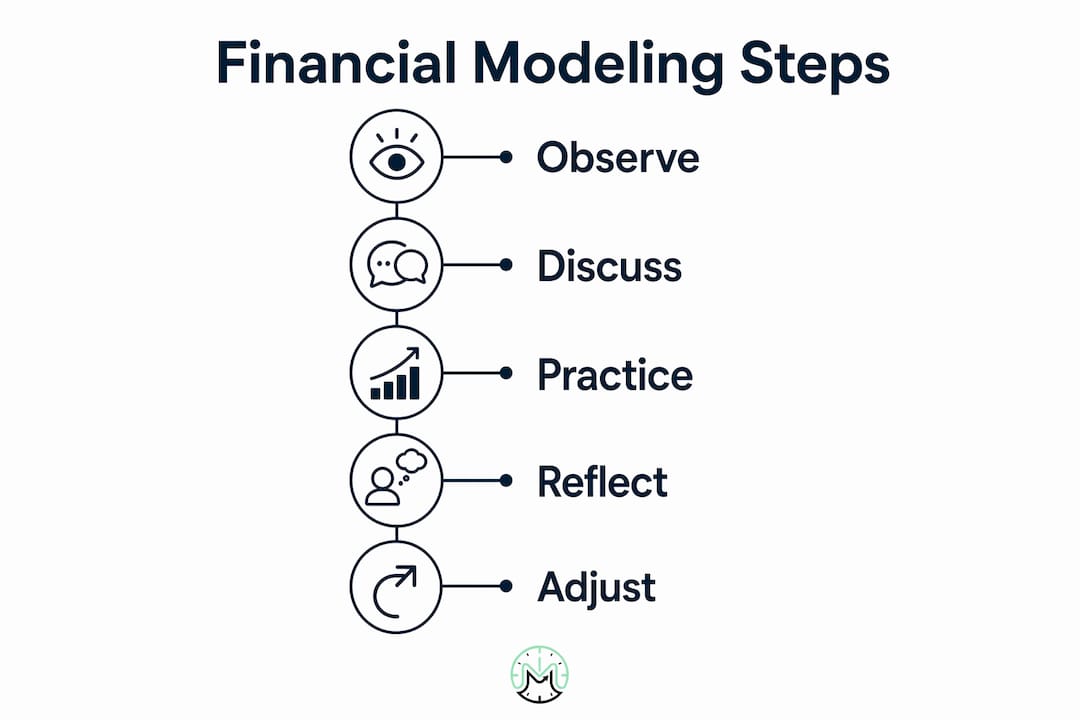
What financial habits do parents most effectively model?
The impact of parental financial behavior shows up most clearly in five core areas. These are the habits worth building deliberately.
-
Responsible spending and budgeting. Children who watch parents compare prices, stick to a list, and say "that's not in the budget" learn that spending has limits. This is the foundation of every other money skill.
-
Delayed gratification. Saving for a goal, whether it is a vacation or a new appliance, shows children that waiting for something is a normal and rewarding part of life. This single habit predicts long-term financial health more reliably than income level.
-
Open, honest conversations about money. Financial psychologist Brad Klontz emphasizes that avoiding money talks passes on financial anxiety rather than protecting children from it. Matter-of-fact, honest conversations reduce money stress and build confidence. You do not need to share every detail, but you should not pretend money is not real.
-
Thoughtful trade-offs. When you choose to cook at home instead of eating out, say why. "We are saving for the trip, so we are skipping the restaurant this week." Children learn that every financial decision involves a choice between two real options.
-
Allowing small mistakes. Permitting low-stakes financial errors builds judgment far more effectively than protecting children from every wrong decision. Let your child spend their allowance on something they regret. That lesson sticks.
Pro Tip: When your child makes a spending mistake, resist the urge to rescue them immediately. Ask "How does that feel?" before offering a solution. The discomfort is the lesson.
How can parents tailor financial modeling by a child's age?
Children's brains develop in stages, and your approach to age-appropriate money lessons should match where your child actually is, not where you wish they were.
| Age range | What children can grasp | Best modeling approach |
|---|---|---|
| Ages 3–7 | Basic concepts: coins have value, money is exchanged for things | Use physical coins and jars; simple "save, spend, give" system |
| Ages 8–12 | Budgets, real costs, comparison shopping | Involve them in grocery trips; show receipts; discuss household bills |
| Ages 13–18 | Credit, interest, bank accounts, income vs. expenses | Open a bank account together; explain interest on real purchases |
Young children need tangible, physical money. A jar they can see filling up is more powerful than a number on a screen. At this stage, the goal is simply connecting the idea that money is finite and choices matter.
Middle childhood is when you can start pulling back the curtain on real family finances. Discussing household expenses like rent and utilities with your children, which more than a third of parents now do, gives kids a realistic picture of adult financial life. It removes the mystery and replaces it with understanding.
Teenagers are ready to move from learning about money to learning with money. Bank account management, debit card use, and understanding how interest works on a credit card are skills they need before they leave home. Waiting until college is too late.
What are practical ways to integrate financial teaching into daily life?
The best financial lessons happen during ordinary moments, not formal family meetings. Financial conversations at home work best when they feel normal, not like a lecture.
Here is what that looks like in practice:
- Grocery shopping. More than half of parents already use grocery trips to demonstrate real-world costs, according to a 2026 Intuit survey. Point out unit prices. Explain why you choose one brand over another. Let your child hold the list and check items off.
- Household bills. Pull up a utility bill and explain what it covers. Show your child what happens when you leave lights on all day. Connect behavior to cost in a concrete way.
- Allowances with autonomy. Give children control over their allowance without micromanaging every purchase. Autonomy builds decision-making skills. Oversight without control builds resentment, not financial literacy.
- Savings goals with rewards. Help your child set a savings goal for something they actually want. Track progress visibly, with a chart on the fridge or a jar with a label. Celebrate when they hit the goal.
- Narrate trade-offs. When you decide not to buy something, say it out loud. "I want that, but we are saving for something more important right now." That sentence models prioritization better than any worksheet.
Making money talk a daily habit rather than a formal event lowers financial anxiety for the whole family. Children who grow up in homes where money is discussed openly and calmly develop healthier financial attitudes as adults. A 2022 Brigham Young University study links early financial education directly to better financial and overall well-being in adulthood. That connection starts at your kitchen table.
Pro Tip: Tie financial conversations to things your child already cares about. If they want a video game, use it as a savings goal. Motivation makes the lesson land.
You can also use chores and money lessons together to build a practical framework. Connecting effort to earnings mirrors how the adult world actually works, and it gives children a sense of agency over their financial situation from a young age.
Minutementor helps parents build money skills fast
Building your own financial confidence makes you a better model for your children. Minutementor delivers five-minute daily lessons that cover budgeting, saving, and investing in plain language you can actually use and share.

The platform's AI-powered coach tailors your learning path to your specific goals, whether that is getting your budget under control or understanding how to talk to your teenager about credit. Parents who feel confident about money pass that confidence on. Start building that confidence with Minutementor today. If you want to see what a full learning plan looks like, the pricing and plan options are straightforward and built for busy schedules.
Key takeaways
Parents who model financial behaviors intentionally and consistently, across every age and every daily moment, produce children with stronger financial literacy and healthier money habits in adulthood.
| Point | Details |
|---|---|
| Parents are the primary influence | Children form lasting money habits by age 5, making early parental modeling critical. |
| Implicit learning never stops | Children absorb your emotional reactions and daily money behaviors even when you are not teaching. |
| Narrate your decisions | Explaining your financial choices out loud turns routine actions into visible money lessons. |
| Match lessons to age | Use physical money for young children, real bills for tweens, and bank accounts for teenagers. |
| Allow small mistakes | Low-stakes financial errors build judgment and teach opportunity cost better than protection does. |
FAQ
Why are parents the biggest influence on children's financial habits?
Parents are the primary influence because children observe financial behaviors daily from birth, long before schools introduce any formal money education. Studies confirm that parental financial socialization outweighs schools, peers, and media combined.
At what age should parents start modeling financial habits?
Parents should start as early as age 3, using physical coins and simple saving jars. Research shows children begin forming permanent financial attitudes by age 5, so earlier exposure builds a stronger foundation.
How do I talk to my child about money without causing anxiety?
Keep money conversations matter-of-fact and routine rather than dramatic or secretive. Financial psychologist Brad Klontz notes that avoiding money talks passes on anxiety, while calm, honest discussions build confidence.
What is the single most effective financial habit to model?
Delayed gratification, saving for a specific goal before spending, is the habit most consistently linked to long-term financial health. Modeling it visibly and narrating the process gives children a clear framework to follow.
How does allowing mistakes help children learn about money?
Permitting low-stakes financial errors, like spending an allowance on something they regret, teaches opportunity cost and financial judgment in a way that lectures cannot. The experience of a real consequence creates durable learning.