
Financial conversations at home are the single most effective tool families have for building shared wealth, reducing money stress, and raising financially confident kids. Most households treat money as a private matter, discussed only when a crisis forces the issue. That silence costs them. Open financial communication helps families teach literacy, align values, prepare for life events, and preserve wealth across generations. The good news: you do not need a finance degree to get started. You need a framework, a little courage, and the right conversation.
What is the role of financial conversations at home?
The role of financial conversations at home is to create a shared language around money that connects practical decisions to personal values. Without that shared language, families make financial choices in isolation, often working against each other without realizing it. Research shows that financial communication reduces misunderstanding and increases financial confidence across every member of the household.
These conversations do two things at once. On the surface, they cover budgets, savings goals, debt repayment, and spending priorities. Underneath, they address trust, identity, safety, and the unspoken power dynamics that shape how money moves through a family. Ignoring the emotional layer means the practical layer never fully works. A budget that one partner resents will not hold. A savings plan that children do not understand will not teach them anything.

The payoff is real. A study with 1,600 married individuals found that people felt closer after financial talks than they expected before starting them. That result matters because fear of conflict is the number one reason families avoid the topic entirely. The conversation you are dreading is almost certainly less painful than you think.
What are the core components of effective financial conversations at home?
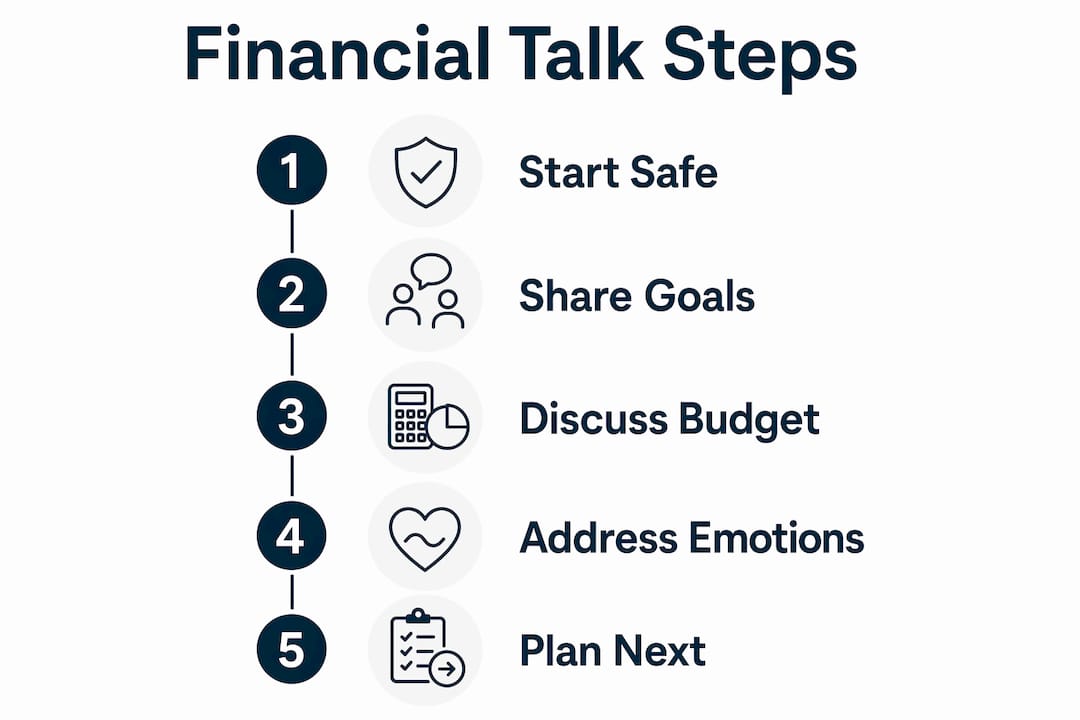
Effective financial talks at home operate on two distinct layers, and you need to address both to make progress. Relationship experts describe these as the content layer and the connection layer. Addressing emotional connection first enables more productive budgeting discussions later. Skip the connection layer and you get defensiveness, shutdown, or a fight about numbers that is really a fight about respect.
The content layer includes:
-
Budgeting and spending: Where money goes each month, and whether that reflects your priorities
-
Savings and emergency funds: How much you are setting aside and what it is for
-
Debt management: What you owe, to whom, and the plan to reduce it
-
Financial goals: Short-term targets like a vacation fund and long-term targets like retirement or a home purchase
The connection layer is harder to see but just as real. It includes each person’s money history, their emotional triggers around spending or saving, and what financial security means to them personally. Someone who grew up in a household where money was always scarce will react differently to a low bank balance than someone who grew up with financial stability. Neither reaction is wrong. Both need space in the conversation.
Pro Tip: Before your next money meeting, spend five minutes each writing down one financial fear and one financial hope. Share those first, before you open a spreadsheet or look at a bank statement. That single step shifts the tone from interrogation to collaboration.
How can families involve children in financial conversations appropriately?
Children are ready to learn about money earlier than most parents assume. Financial psychologists recommend starting as early as age 7 with transparent but age-appropriate examples. Waiting until kids are teenagers means missing years of habit formation that shape adult financial behavior.
Here is a practical sequence for bringing children into household money conversations:
-
Start with visible, everyday examples. Use grocery shopping as a live lesson. Show your child the total before you pay. Explain that you chose the store brand pasta because it costs less and tastes the same. That is a real budget decision, explained in real time.
-
Explain the word “no” honestly. When a child asks for something you are not buying, say “that is not in our budget this week” instead of “we cannot afford it.” The first teaches prioritization. The second can create anxiety about financial security.
-
Set savings goals together. If your child wants a toy or a game, help them track progress toward it. A simple chart on the fridge works. This builds the habit of delayed gratification before it matters at scale.
-
Share household expenses without the stress. Advisors advocate a “public information” boundary when talking to kids. Utility bills, grocery costs, and rent or mortgage payments are fair game. Salary figures, debt totals, and retirement account balances are generally kept between adults.
-
Celebrate financial wins as a family. Paid off a credit card? Hit a savings milestone? Tell the kids. It reinforces that financial goals are achievable and worth working toward.
Early money education sets children on a path for healthier financial habits that improve their adult well-being. That is not a small return on a few dinner table conversations.
Pro Tip: Give children a small, fixed amount of money to manage during a grocery run. Let them make choices within that limit. The experience of running out of budget before running out of wants is the most effective financial lesson there is.
What common barriers prevent open money talks at home, and how to overcome them?
Money is the most emotionally loaded topic most families never discuss openly. Silence on financial matters creates shame, guilt, and fear, while normalizing conversations reduces stress and builds shared understanding. The barriers are real, but they are not permanent.
The most common ones look like this:
-
Cultural taboo: Many families treat money as a private matter, passed down as an unspoken rule across generations. Talking about it feels like a violation of that norm.
-
Fear of judgment: Admitting you overspent, carry debt, or do not understand investing feels vulnerable. People avoid conversations where they might look irresponsible or ignorant.
-
Past family experiences: If money conversations in your childhood home meant fighting, silence, or crisis, your nervous system learned to treat the topic as dangerous. That response does not disappear in adulthood.
-
Power imbalances: When one partner earns significantly more, or one manages all the finances, the other can feel excluded or controlled. That dynamic makes honest conversation harder.
The most underrated fix is nervous system regulation. Conversations must be delayed until all parties feel safe, rested, and regulated for problem-solving. Do not start a money conversation when someone just walked in the door from a stressful day, when anyone is hungry, or when a previous argument is still unresolved. Timing is not a soft consideration. It is a structural one.
“Avoiding money talks stems from culturally reinforced taboos and individual fear, but ongoing discussion builds trust and resilience.” The families who talk about money regularly are not the ones without financial problems. They are the ones who solve problems before they become crises.
Normalize the topic through repetition and lightness. Humor works. Calling your monthly budget review “the money meeting” and making it a ritual with coffee and no phones changes the emotional texture of the conversation. Financial consultants highlight ongoing practice as key to shifting money from a secret to a manageable resource.
What practical steps can families take to establish regular financial conversations?
Sustainable financial dialogue at home requires structure, not just good intentions. The families who communicate well about money do not wait for a crisis to trigger the conversation. They build rituals that make it routine.
-
Schedule a monthly money meeting. Put it on the calendar like any other appointment. Start with 15 minutes of connection before you look at any numbers. Ask how each person is feeling about money this month, not just what the numbers say.
-
Use the “third chair” approach. This technique, drawn from relationship-focused financial counseling, places the financial problem in an imaginary third chair across from both of you. You and your partner sit side by side, facing the problem together rather than facing each other as opponents. This approach transforms financial decision-making from adversarial to collaborative.
-
Start with values, not numbers. Ask: “What does financial security mean to you?” or “What would you do with an extra $500 this month?” Those answers reveal priorities that raw budget data never shows.
-
Practice active listening. Repeat back what you heard before responding. “So what I’m hearing is that you feel anxious when our savings drop below a certain level. Is that right?” That one habit prevents most money arguments from escalating.
-
Use tools to create shared visibility. Apps like YNAB (You Need a Budget) or Monarch Money give both partners a real-time view of the same financial picture. Shared visibility removes the information gap that fuels suspicion and conflict.
Here is how different conversation approaches compare in practice:
| Approach | What it looks like | Likely outcome |
|---|---|---|
| Crisis-only talks | Discuss money only when bills are overdue or accounts are low | High stress, reactive decisions, recurring conflict |
| Scheduled money meetings | Monthly check-ins with a set agenda and connection time first | Proactive planning, shared ownership, reduced anxiety |
| Values-first conversations | Begin with goals and feelings before reviewing numbers | Stronger alignment, more creative problem-solving |
| Third chair method | Frame problems as shared challenges, not personal failures | Less defensiveness, faster resolution |
Ongoing financial talks build stability and reduce the risk of financial conflict derailing a relationship. The structure you build now pays dividends for years.
Key takeaways
Financial conversations at home work best when they address both the practical numbers and the emotional context behind them, practiced consistently as a household ritual rather than a crisis response.
| Point | Details |
|---|---|
| Start with connection, not numbers | Address emotional safety before reviewing budgets to get honest, productive dialogue. |
| Involve children early | Begin age-appropriate money talks by age 7 using everyday examples like grocery shopping. |
| Name and remove barriers | Identify cultural taboos, fear of judgment, and timing issues before they shut conversations down. |
| Use structure and rituals | Monthly money meetings with a set agenda create consistency and reduce anxiety over time. |
| Shared visibility reduces conflict | Tools like YNAB or Monarch Money give all partners the same financial picture, removing information gaps. |
Why financial conversations changed how I think about money
I used to believe that financial literacy was primarily an information problem. Learn enough about budgets, compound interest, and index funds, and everything else would follow. I was wrong. The families and individuals who struggle most with money are rarely missing information. They are missing the conversations.
What I have seen repeatedly is that creating safety changes the nature of financial decisions entirely. When people feel judged for their spending, they hide it. When they feel heard about their financial fears, they engage. The moment a household stops treating money as a performance and starts treating it as a shared project, the numbers actually start to improve. Not because the math changed, but because the behavior did.
The other thing I would push back on is the idea that you need to have everything figured out before you start talking. Starting small is not a compromise. It is the strategy. One honest conversation about what financial security means to you and your family is worth more than a perfect budget that nobody follows. Build the habit first. The sophistication comes with practice.
— Aryan
Build your family’s financial confidence with Minutementor
If these conversations feel like a lot to take on at once, you are not alone. Most families have never been taught how to talk about money, let alone how to make it a positive habit.

Minutementor is built for exactly this. The platform delivers five-minute daily lessons on budgeting, saving, debt, and financial goal-setting, tailored to where you are right now. Whether you are a parent trying to model good money habits, a couple working toward shared goals, or an individual building confidence from scratch, Minutementor’s AI-powered coach creates a learning path that fits your life. Start with one lesson today and see how quickly the conversations at home start to shift.
FAQ
What is the role of financial conversations at home?
Financial conversations at home build trust, align family members around shared goals, and develop financial literacy across generations. They address both practical money management and the emotional relationship each person has with money.
How often should families talk about money?
A monthly money meeting is the minimum for most households, with brief weekly check-ins during periods of active goal-setting or financial change. Consistency matters more than frequency.
At what age should children be included in financial talks?
Financial psychologists recommend starting at age 7 with age-appropriate examples like grocery budgets and savings goals. Sensitive details like salaries or total debt are generally kept between adults.
Why do so many families avoid talking about money?
Money avoidance stems from cultural taboos, fear of judgment, and past experiences where financial conversations meant conflict or crisis. Ongoing practice is the most effective way to reduce that anxiety over time.
Does talking about money actually improve financial outcomes?
Yes. Research shows that regular financial communication helps couples and families adapt to changing goals, reduce conflict, and build long-term stability. The conversation itself is a financial tool.