Books are the most accessible entry point into financial literacy, turning abstract money concepts into stories, systems, and strategies that stick. The role of books in money education spans every life stage. Whether you are a parent reading to a five-year-old about saving, a college student wrestling with student debt, or a young professional trying to understand investing, the right book meets you exactly where you are. This article covers how financial literacy books work across age groups, which titles and categories deliver the most impact, and how to use them as active learning tools rather than passive reads.
How books teach money management to children
Children's financial literacy books are effective teaching tools for ages 3 to 10 because they wrap real money concepts inside stories kids already want to hear. A child does not need to understand compound interest to grasp that saving a little each week builds toward something bigger. That is exactly what well-designed children's books deliver.
The best titles in this space do more than explain money. They build critical thinking. When a character in a story has to choose between buying a toy now or saving for a bike later, the child reading along is practicing the same decision-making muscle they will use for the rest of their financial life. Series like Moe's Money Moves are built around this principle, using guided reflection sections to spark conversations between kids and caregivers after each story.

There is also a dual benefit that most parents overlook. Financial literacy books strengthen reading skills like decoding, phonics, and comprehension at the same time they teach money habits. You are not choosing between reading practice and money education. You are getting both in one sitting. That is a significant return on a 15-minute bedtime story.
Research confirms the long-term payoff. Children exposed to money education through literature show measurably better financial attitudes and fewer risky money behaviors as they grow up. The habits formed early are the ones that last.
Here is what the best children's financial books consistently cover:
- Needs vs. wants: Teaching kids to distinguish between what they need and what they simply want is the foundation of every budgeting skill they will ever use.
- Saving with a purpose: Stories that show characters saving toward a specific goal make the concept concrete and motivating, not abstract.
- Earning and entrepreneurship: Books like those in the Money Monsters series introduce the idea that money comes from effort, creativity, and problem-solving, not just from parents.
- Giving and sharing: Many top titles include a giving component, which teaches generosity alongside personal finance.
Pro Tip: After reading a money-themed book with your child, ask one open-ended question like "What would you have done differently than the character?" This single habit turns a story into a financial conversation that builds real decision-making skills.
Why young professionals need behavioral finance books
The financial books that resonate most with millennials and Gen Z have moved away from dry investing theory. They focus on behavior, psychology, and the real-world pressures that define modern financial life. This shift is not accidental. It reflects where most young adults actually get stuck.
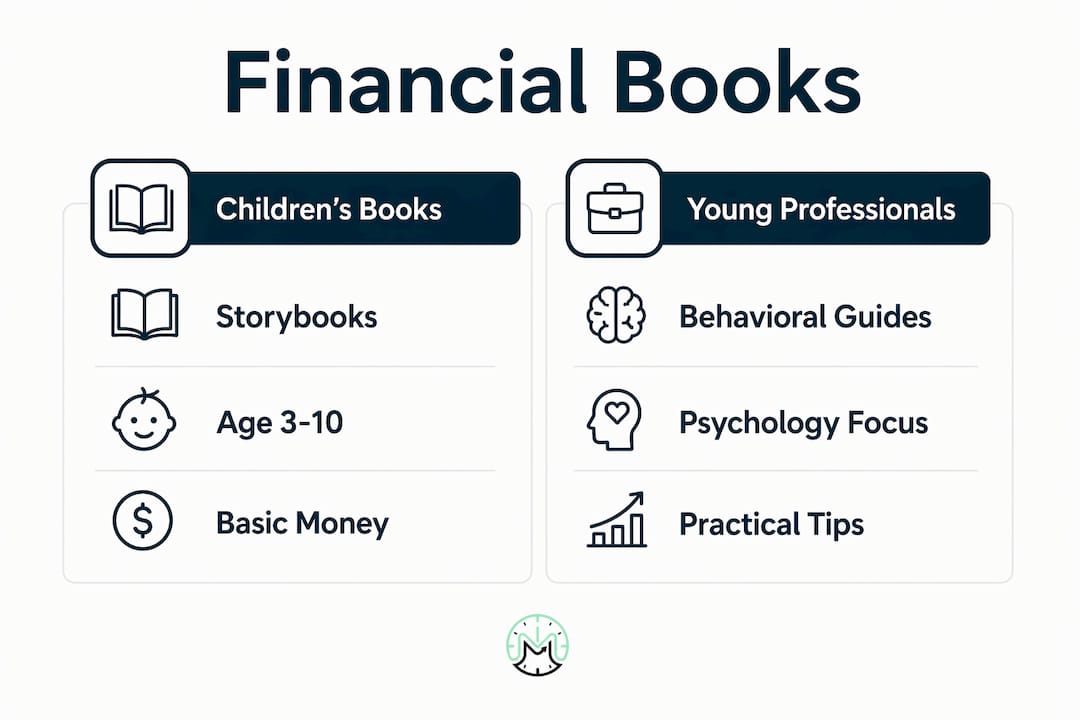
The most common failure pattern for young professionals is skipping psychological self-reflection before adopting technical money systems. You can read every budgeting spreadsheet tutorial online, but if your relationship with money is driven by anxiety, shame, or avoidance, the spreadsheet will not save you. Books like Good With Money by Emma Edwards address this directly. Edwards argues that unpacking emotional money habits is the necessary first step before any technical strategy can work. That framing has made the book a standout for readers who have tried and failed with conventional financial advice.
Here is how the best books for young professionals are structured to actually produce change:
- Start with money beliefs. Titles like Good With Money open by examining where your money attitudes came from, whether that is family, culture, or past financial trauma. You cannot fix what you have not identified.
- Address modern financial realities. Books like Get a Financial Life by Beth Kobliner tackle student debt and neobanks alongside digital currencies and high cost-of-living pressures. These are not topics covered in books written for previous generations.
- Build practical systems. After the psychological groundwork, the best books move into concrete strategies: automating savings, understanding tax basics, and building an emergency fund. Check out investing as a young professional for a practical companion to this reading.
- Normalize financial struggle. Judgment-free language matters. Books that treat financial mistakes as learning opportunities rather than moral failures keep readers engaged instead of defensive.
- Price accessibility. Most bestselling finance books in 2026 are priced between $15 and $35, making them one of the highest-return investments a young professional can make.
Pro Tip: Read the first and last chapters of any personal finance book before committing to the full read. The opening chapter reveals the author's core philosophy, and the final chapter shows whether their advice lands in a place that matches your goals. This approach works especially well with longer titles like The Intelligent Investor.
Comparing types of financial education books by audience
Not all financial books serve the same purpose. Choosing the wrong type for your audience is the fastest way to lose interest and abandon the habit entirely. The table below maps the four main categories of financial literacy books to their ideal readers and primary outcomes.
| Book type | Best audience | Key topics | Primary outcome |
|---|---|---|---|
| Children's storybooks | Ages 3 to 10 | Saving, needs vs. wants, earning | Early money habits and reading skills |
| Behavioral finance guides | Millennials and Gen Z | Money psychology, debt, identity | Behavior change and emotional clarity |
| Technical manuals | Advanced readers, investors | Value investing, tax strategy, ETFs | Knowledge depth and portfolio skills |
| Systems-based learning tools | Parents, educators | Budgeting frameworks, family finance | Confidence and normalized money talk |
Children's storybooks like those in the Money Monsters program from the Consumer Financial Protection Bureau are purpose-built for early education. They come with companion workbooks and guided questions that make them useful in both home and classroom settings. The structured format means a parent does not need a finance degree to lead a productive money conversation.
Behavioral guides like The Psychology of Money by Morgan Housel sit in a different category entirely. They are written for readers who already understand basic money mechanics but struggle to act on that knowledge consistently. Housel's core argument is that financial success is less about intelligence and more about behavior over time. That insight alone has changed how thousands of readers approach their finances.
Technical manuals like Benjamin Graham's The Intelligent Investor reward a selective reading approach. Focusing on key chapters rather than reading cover to cover reduces overwhelm and accelerates learning. This is not cutting corners. It is reading strategically, which is exactly what experienced investors do.
For parents looking to build financial conversations at home, systems-based books provide the clearest frameworks. They translate financial principles into family-friendly language and give parents concrete tools for discussing money without anxiety.
How parents and educators can use books to build lasting money habits
Books work best as conversation starters, not finish lines. The most effective financial literacy education treats reading as the beginning of a discussion, not the end of one. A child who reads a story about saving and then gets asked "What would you save for?" is building a habit. A child who reads the same story and moves on is just reading.
Here are the most effective strategies for using financial books at home and in the classroom:
- Create a post-reading ritual. After finishing a money-themed book, spend five minutes asking open-ended questions. "What did the character do well?" and "What would you do differently?" are simple prompts that generate real financial thinking.
- Connect stories to real life. When a book character earns money by doing chores, tie that directly to your child's own experience. Real-world connections make abstract lessons concrete and memorable.
- Use companion materials. Programs like Moe's Money Moves include guided reflection sections specifically designed to normalize money conversations and reduce financial anxiety in children. These materials do the heavy lifting for parents who are not sure where to start.
- Build a reading routine around financial themes. Rotating one money-focused book into your monthly reading list, whether for a child or yourself, keeps financial literacy top of mind without making it feel like homework.
- Pair books with small real-money experiences. Give a child a small amount to manage after reading a book about budgeting. The hands-on practice locks in the lesson far more effectively than the story alone.
Understanding why financial education matters for youth goes beyond books alone, but books remain the most scalable and affordable tool available to parents and educators. A $12 picture book read ten times delivers more financial education per dollar than almost any other resource.
Build on your reading with Minutementor

Books give you the foundation. Minutementor helps you build on it every single day. The platform delivers five-minute daily financial lessons through an AI-powered personal finance coach that adapts to your specific goals, whether that is budgeting, paying down debt, or starting to invest. If you have just finished a book on behavioral finance or you are looking for a structured way to put what you read into practice, Minutementor turns those ideas into personalized learning paths you can actually follow. Students, young professionals, and parents all use it to build money skills fast without needing hours of free time. Start your first five-minute lesson today and level up your financial confidence.
FAQ
What is the role of books in money education?
Books serve as structured, accessible tools that translate financial concepts into relatable narratives and practical frameworks. They build financial literacy across age groups by combining knowledge, behavior change, and confidence in a single resource.
Which books are best for teaching kids about money?
Series like Money Monsters from the Consumer Financial Protection Bureau and Moe's Money Moves are designed specifically for children ages 3 to 10, covering saving, earning, and needs vs. wants through engaging stories with companion activities.
How do financial books help young professionals?
Books like Good With Money by Emma Edwards and Get a Financial Life by Beth Kobliner address the psychological and practical financial challenges facing millennials and Gen Z, including student debt, money anxiety, and building wealth in high cost-of-living environments.
Do children's financial books actually improve money behavior?
Studies confirm that children exposed to money education through literature show measurably better financial attitudes and fewer risky financial behaviors later in life. Early exposure creates habits that persist into adulthood.
How should parents use financial books most effectively?
The most effective approach treats books as conversation starters rather than standalone lessons. Pairing reading with open-ended questions, real-money experiences, and companion workbooks, as programs like Money Monsters provide, produces far greater learning retention than reading alone.
Key takeaways
Books are the most cost-effective and age-adaptable tools for building financial literacy, but their full impact depends on active use through conversation, reflection, and real-world practice.
| Point | Details |
|---|---|
| Books work across all ages | Children's storybooks, behavioral guides, and technical manuals each serve distinct audiences with targeted outcomes. |
| Behavior precedes strategy | Young adults must address emotional money habits before technical systems like budgeting or investing can take hold. |
| Active reading multiplies impact | Post-reading questions and companion activities produce far stronger financial habits than passive reading alone. |
| Early exposure pays off | Children introduced to money concepts through books show better financial attitudes and fewer risky behaviors as adults. |
| Accessibility matters | Most top finance books cost between $15 and $35, making them one of the highest-return tools for financial education. |