A money games educational checklist is a structured evaluation tool that helps you identify which financial literacy games actually teach budgeting, saving, credit, and spending through hands-on practice. Not every game labeled "educational" delivers real learning. The best ones use decision-driven mechanics, realistic scenarios, and age-matched complexity to build skills that stick. Programs like the FDIC Money Smart suite, the Teen Paycheck Challenge, and BOJ Money Quest set the standard for what effective interactive money learning looks like. This article gives you a practical, expert-informed checklist to find and use the best options.
1. What key financial skills should a money game cover?
The strongest financial literacy games don't just teach one concept. They cover the full range of personal finance skills you actually use in real life. When you evaluate any game, check that it addresses all four core domains.
Here's what your money management checklist should look for in every game:
- Budgeting and spending: The game should require players to allocate limited funds across competing needs, not just track spending passively. Look for scenarios where overspending has visible consequences.
- Saving and goal-setting: Players should set a savings target and work toward it across multiple rounds or sessions. Games that skip this teach spending without purpose.
- Credit and borrowing basics: Even younger learners benefit from simple borrowing scenarios. Look for games that show interest accumulating or debt growing when payments are missed.
- Everyday financial decisions: Grocery choices, transportation costs, and unexpected bills should appear as realistic decision points, not abstract math problems.
- Progress tracking: The FDIC Money Smart program includes certificates of completion and account-based progress monitoring. Any strong game should show learners how far they've come.
Pro Tip: If a game only covers one domain, like saving, pair it with a second game that covers spending or credit. Financial literacy is a system, not a single skill.
These categories come directly from FDIC's Money Smart interactive resource hub as foundational financial literacy topics, which makes them the most credible benchmark available for checklist building.
2. How interactive simulations like the Teen Paycheck Challenge build real skills
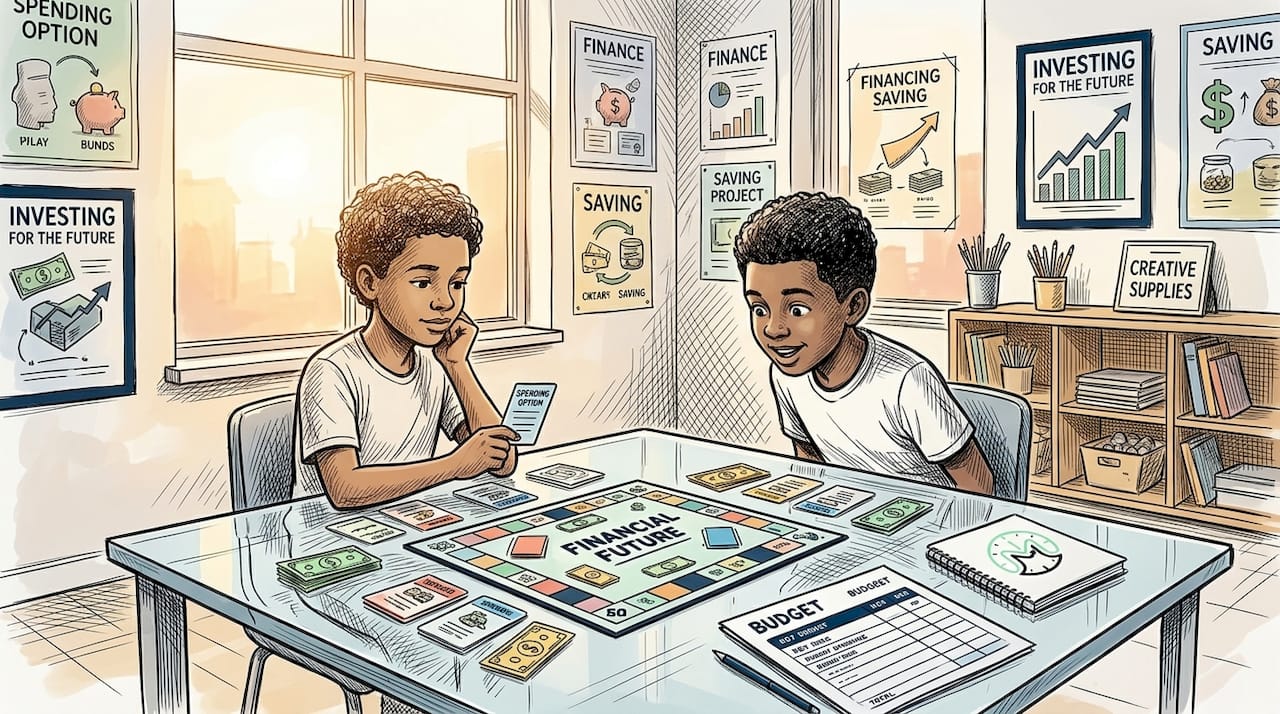
Passive instruction tells you what money management looks like. Simulations make you practice it under pressure. The Teen Paycheck Challenge is one of the clearest examples of how realistic simulation games translate financial concepts into lived experience.
Here's how the Teen Paycheck Challenge works, step by step:
- Choose a job profile. The game includes 24 realistic job profiles with hourly wages and tax deductions already calculated. Students immediately see the gap between gross and net pay.
- Complete earnings worksheets. Players calculate take-home pay and record it on structured worksheets, reinforcing the math behind every paycheck.
- Build a monthly budget. Students allocate their net income across housing, food, transportation, and personal expenses. Every dollar must be assigned.
- Draw event cards. Unexpected expenses appear mid-game: a car repair, a medical bill, a friend's birthday. Players must adjust their budget in real time.
- Reflect on outcomes. The final reflection prompts ask students what surprised them, what they'd change, and what habits they want to carry into real life.
"Realistic simulations incorporating taxes, wages, and unexpected expenses prepare teens for real-world financial challenges more effectively than any worksheet alone." — Teen Paycheck Challenge design principle
The simulation runs across two to three class periods, which gives students enough time to feel the consequences of early decisions without losing momentum. That pacing is a design feature, not an accident. When you evaluate budgeting games for kids or teens, look for this kind of structured arc: setup, decision, consequence, reflection.
3. Why age and grade calibration determines whether a game actually works
A game that's too simple bores players. A game that's too complex loses them. Matching game difficulty to learner age is one of the most important and most overlooked criteria in any educational money activities checklist.
BOJ Money Quest targets Grades 4 through 6 specifically, covering saving, budgeting, goal-setting, and responsible spending at a complexity level matched to that cognitive range. It runs on phones, tablets, and computers, which removes access barriers while keeping the content calibrated. That combination of curriculum alignment and device flexibility is the benchmark for age-appropriate design.
Here's a quick comparison to guide your selection:
| Age group | Recommended game type | Key features to look for |
|---|---|---|
| Grades K–3 | Coin and counting games | Visual currency, simple choices, immediate feedback |
| Grades 4–6 | Goal-setting simulations (e.g., BOJ Money Quest) | Saving targets, spending categories, curriculum alignment |
| Grades 7–10 | Budget simulations (e.g., Teen Paycheck Challenge) | Wages, taxes, unexpected expenses, reflection prompts |
| Grades 11+ / Adults | Full financial simulators | Investing, credit, retirement planning, leaderboard scoring |
Cognitive overload is a real risk. When a game introduces taxes, interest rates, and investment returns all at once to a 10-year-old, the player stops learning and starts guessing. Age-appropriate calibration prevents this and significantly improves knowledge retention.
Pro Tip: When teaching kids about money with a new game, run a five-minute trial round with no stakes. Watch where players hesitate or make random choices. That's your signal the game may be pitched too high.
4. What features make money games genuinely engaging
Good game design and good financial education share one requirement: the player must make real decisions with real consequences. When that loop is missing, the game becomes a quiz with a leaderboard. When it's present, learning happens automatically.
The features that separate effective educational money activities from forgettable ones include:
- Timed decision mechanics: The Money Life Simulator uses 15-second decision timers and leaderboard scoring to maintain engagement. Time pressure forces instinctive choices, which then become teachable moments when the consequences appear.
- Virtual currency with real stakes: Using virtual money combined with scenario cards gives players authentic financial decision experiences without real financial risk. Students at New World School of the Arts in Miami used this approach to practice budgeting and investing in a classroom setting.
- Leaderboards and scoring: Competitive elements motivate players to replay and improve. More replays mean more practice. More practice means stronger retention.
- Immediate cause-and-effect feedback: When a player overspends on rent and can't cover groceries, the game should show that consequence immediately, not at the end of the session. Delayed feedback breaks the learning loop.
- Scenario variety: A game that only simulates one type of financial situation gets stale fast. Look for games with rotating scenario cards or randomized events that keep each session different.
Interactive, decision-driven games improve knowledge retention by engaging players to apply concepts and experience consequences directly. That's the core advantage over passive instruction, and it's why game-based financial learning is gaining ground in classrooms and homes alike.
5. How to build and use your own money games educational checklist
You don't need to evaluate every game from scratch. A well-built checklist turns game selection from guesswork into a repeatable process. Here's how to build one that works for your specific learner or classroom.
Step 1: Define your learner profile. Write down the age or grade level, current financial knowledge, and one or two specific skills you want to build. A 16-year-old who has never seen a paycheck needs something different from a college freshman managing their first checking account.
Step 2: Map your checklist to the four core domains. Use the FDIC Money Smart framework as your baseline: budgeting and spending, saving and goal-setting, credit and borrowing, and daily financial management. Every game you evaluate should score on at least two of these.
Step 3: Score each game on engagement mechanics. Use this table as your scoring guide:
| Checklist criterion | What to look for | Example |
|---|---|---|
| Decision-driven gameplay | Player choices have visible consequences | Teen Paycheck Challenge event cards |
| Age-appropriate complexity | Difficulty matches grade band | BOJ Money Quest (Grades 4–6) |
| Feedback speed | Consequences appear immediately or within the same round | Money Life Simulator timers |
| Reflection component | Post-game prompts connect play to real life | Teen Paycheck Challenge reflection worksheets |
| Progress tracking | Scores, certificates, or levels show growth | FDIC Money Smart completion certificates |
Step 4: Add reflection prompts to every session. Structured reflection after game play helps students internalize lessons and connect them to real-life money management. Three questions work well: What surprised you? What would you do differently? What will you change about how you handle money this week?
Step 5: Validate your checklist against a proven program. Run your criteria against FDIC Money Smart or the Teen Paycheck Challenge. If those programs score well on your checklist, your criteria are solid. If they don't, revisit your scoring weights.
Step 6: Integrate games into a regular routine. One session every two weeks is enough to build momentum. Pair each game session with a five-minute debrief and one real-world money task, like reviewing a bank statement or setting a weekly spending limit.
Pro Tip: For parents teaching kids about money at home, check out financial conversations at home to reinforce what games teach. The combination of play and conversation accelerates learning faster than either approach alone.
Setting financial goals in your 20s becomes significantly easier when you've already practiced budgeting and saving through games during your teens. The habits built in play transfer directly to real decisions.
Key takeaways
The most effective money games educational checklist combines age-matched complexity, decision-driven mechanics, and structured reflection to build financial literacy skills that transfer to real life.
| Point | Details |
|---|---|
| Cover all four domains | Every strong game addresses budgeting, saving, credit, and daily decisions. |
| Match difficulty to age | Grade-banded games like BOJ Money Quest prevent cognitive overload and improve retention. |
| Prioritize decision loops | Timed choices and immediate consequences, as seen in the Money Life Simulator, drive deeper learning. |
| Add reflection every time | Post-game prompts from programs like the Teen Paycheck Challenge connect play to real behavior change. |
| Validate against proven programs | Use FDIC Money Smart as your benchmark to confirm your checklist criteria are sound. |
Level up your financial skills with Minutementor
Minutementor is built for exactly this kind of learning. Five-minute daily lessons cover budgeting, saving, investing, and debt management through interactive modules that mirror the decision-driven design of the best financial literacy games. The AI-powered personal finance coach tailors your learning path to your specific goals, so you're never stuck on content that's too basic or too advanced.
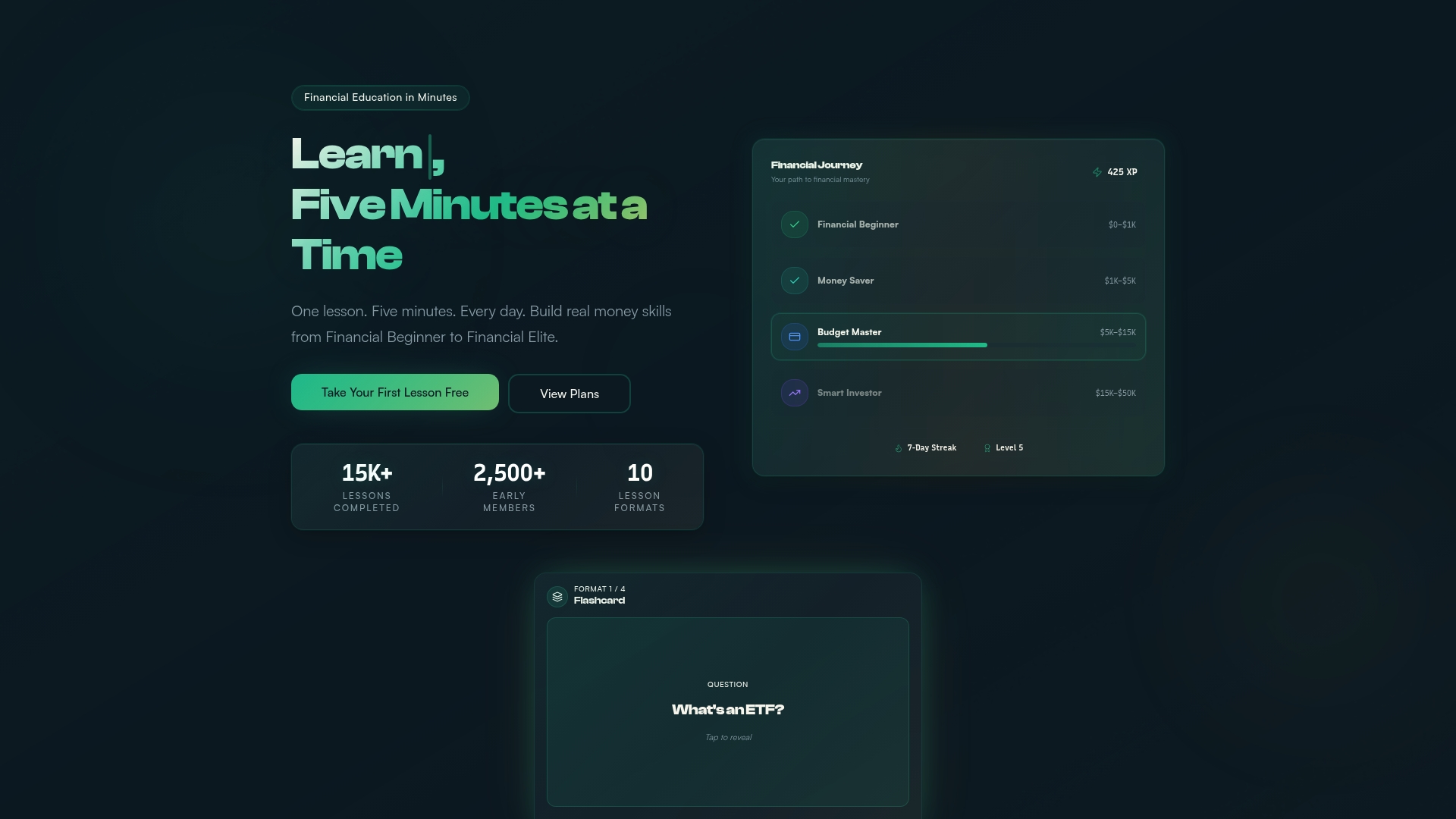
Whether you're a student building your first budget or a young professional working toward bigger financial goals, Minutementor meets you where you are. Progress tracking and gamified motivation keep you moving forward every day. Start your personalized learning plan today and see how fast five minutes a day adds up. Check out Minutementor's pricing to find the plan that fits your goals.
FAQ
What is a money games educational checklist?
A money games educational checklist is a structured set of criteria used to evaluate whether a financial literacy game covers core skills like budgeting, saving, credit, and spending through interactive, age-appropriate gameplay. It helps parents, educators, and learners select games that deliver real learning outcomes rather than surface-level entertainment.
Which financial skills should budgeting games for kids cover?
The strongest budgeting games for kids cover at least two of four core domains: budgeting and spending, saving and goal-setting, credit and borrowing, and everyday financial decisions. The FDIC Money Smart program uses these four domains as its foundational framework for financial literacy education.
How do I know if a money game is age-appropriate?
Check whether the game is designed for a specific grade band. BOJ Money Quest targets Grades 4 through 6 with curriculum-aligned content, while the Teen Paycheck Challenge suits Grades 7 through 10. A game pitched too high introduces cognitive overload; one pitched too low fails to build new skills.
What makes interactive money learning more effective than reading about finance?
Decision-driven games require players to apply concepts and experience consequences directly, which improves knowledge retention more than passive instruction. The Bank of Jamaica cited this principle in the design of BOJ Money Quest, and it's the core reason simulation-based tools outperform textbooks for financial education.
Do money games need a reflection component to be effective?
Yes. Structured reflection after game play is what connects the experience to real-life behavior change. The Teen Paycheck Challenge includes final reflection prompts asking students what surprised them and what habits they want to carry forward, turning a classroom simulation into a genuine learning milestone.