Investing spare cash wisely means allocating surplus funds across the right mix of accounts and assets based on your time horizon, risk tolerance, and financial priorities. Before you pick a single stock or open a brokerage account, your sequencing matters more than your stock picks. Vanguard, the DFPI (California Department of Financial Protection and Innovation), and Navy Federal Credit Union all point to the same framework: build your safety net first, eliminate high-cost debt second, then put your money to work. Get the order right and your investments compound without interruption. Get it wrong and you sell at the worst possible time.
How to invest spare cash wisely: build your foundation first
The single biggest mistake new investors make is skipping straight to the market before their financial base is solid. Two steps come before any investment decision.
Step 1: Build your emergency fund

Maintain 3 to 6 months of living expenses in a liquid account before you invest a single dollar. Navy Federal Credit Union recommends a high-yield savings account for this purpose specifically because it prevents you from being forced to sell investments at a loss during a financial emergency. That forced liquidation risk is real. If your car breaks down and your only money is in a brokerage account that is down 15%, you either sell at a loss or go into debt.
High-yield savings accounts currently offer competitive rates, and money market accounts provide a similar function with slightly more flexibility. Both are FDIC-insured up to $250,000, which means your safety net carries zero market risk.
Step 2: Pay off high-interest debt
Prioritize paying down debts with an APR above 8% before investing, according to the DFPI. The logic is straightforward. A credit card charging 22% APR guarantees you a 22% return the moment you pay it off. No index fund offers that with certainty. Eliminating that debt first is the highest-returning move available to you.
Pro Tip: If you carry both a 5% student loan and a 24% credit card balance, pay the credit card first every time. The math is not close.
Once your emergency fund is funded and high-interest debt is cleared, sequencing your financial priorities this way means your investment portfolio can grow without disruption from cash flow shocks.
What investment options are best based on your time horizon?
The single most important variable in choosing where to put spare cash is when you will need it back. Vanguard frames this as a bucket approach to spare cash: divide your money by when you need it, then match each bucket to the right vehicle.
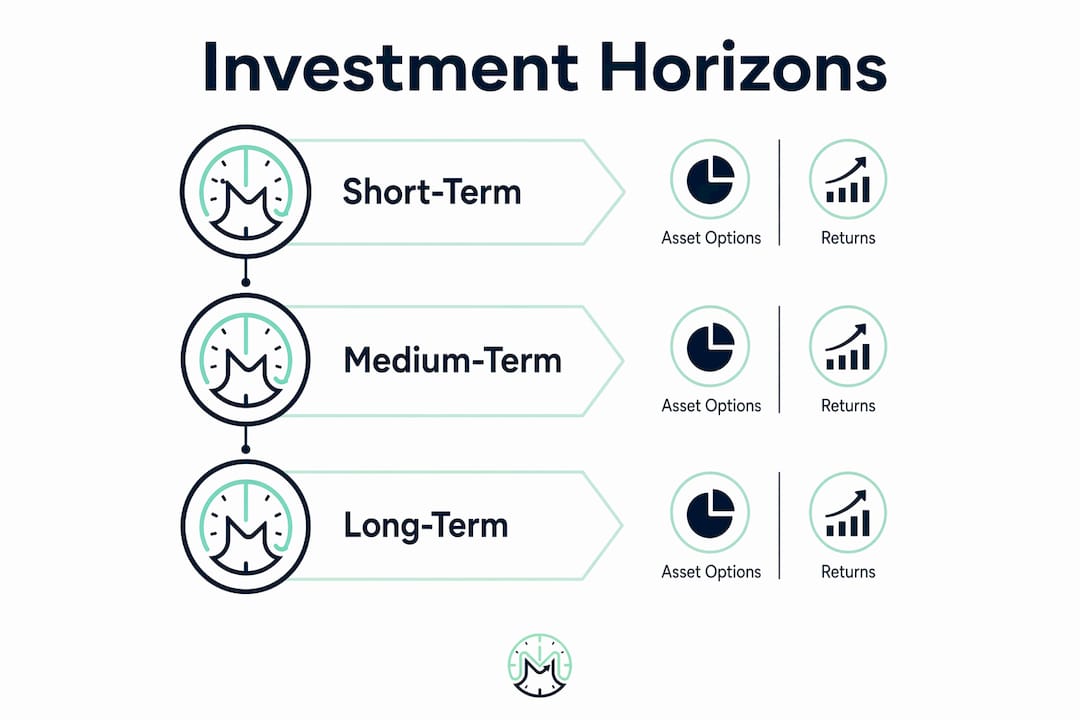
| Time Horizon | Best Options | Expected Return Range |
|---|---|---|
| 0 to 2 years | High-yield savings, money market funds, CDs | 4.5% to 5.0% APY |
| 3 to 10 years | Bond funds, balanced funds, I-bonds | 4% to 7% annually |
| 10+ years | Stock index funds, target-date funds, ETFs | 7% to 10% historically |
For money you need within 12 to 24 months, stocks can fall 20 to 30% in a single year, which makes them a poor choice for near-term cash needs. Firstcard points out that a high-yield savings account offering 4.5% to 5.0% APY is the smarter vehicle for short-term spare cash. That return is modest but guaranteed, and your principal stays intact.
For medium-term goals like a home down payment in five years, bond funds and balanced funds offer more growth than a savings account without the full volatility of equities. For money you will not touch for a decade or more, stock index funds and target-date funds are the standard recommendation because time absorbs short-term volatility and lets compounding do the heavy lifting.
Pro Tip: If you are saving for a specific goal like a house or a car, write the target date on a sticky note next to your computer. That date determines your investment vehicle, not your feelings about the market.
How does asset allocation improve your investment outcomes?
Asset allocation is the practice of dividing your portfolio across stocks, bonds, and cash to balance growth against risk. It is not a one-time decision. It is a living framework that shifts as you age and your goals evolve.
Navy Federal promotes the 100 minus your age rule as a starting point for stock allocation. A 30-year-old would hold roughly 70% in stocks and 30% in bonds and cash. A 55-year-old would hold 45% in stocks. This rule is a starting guide, not a law, but it captures the core principle: the less time you have to recover from a market drop, the less risk you should carry.
Diversification works because different asset classes do not move in lockstep. When U.S. stocks fall, international bonds may hold steady. When growth stocks drop, dividend stocks often hold value better. Spreading across asset classes smooths your returns over time and reduces the chance of a single bad year wiping out years of gains.
Here is how three sample portfolios look at different risk levels:
| Risk Level | Stocks | Bonds | Cash/Equivalents |
|---|---|---|---|
| Conservative | 30% | 50% | 20% |
| Moderate | 60% | 30% | 10% |
| Aggressive | 85% | 10% | 5% |
Risk tolerance and time horizon evolve as you age, and adjusting your portfolio accordingly preserves capital while maximizing growth potential. Review your allocation at least once a year or after any major life change like a new job, marriage, or a child.
Step-by-step guide to start investing spare cash
You do not need a financial advisor or a large sum to get started. You need a clear sequence and the discipline to follow it.
-
Assess your financial baseline. Calculate your monthly expenses and confirm your emergency fund covers 3 to 6 months. Check your debt balances and identify any with APR above 8%.
-
Calculate your true spare cash. After rent, groceries, utilities, minimum debt payments, and emergency fund contributions, what is left? That number is your investable surplus. Be honest. Overestimating leads to selling investments early.
-
Choose the right account type. For long-term goals, a Roth IRA or Traditional IRA offers tax advantages that a standard brokerage account does not. For medium-term goals, a taxable brokerage account through Fidelity, Charles Schwab, or Vanguard works well. For short-term cash, a high-yield savings account at Marcus by Goldman Sachs or Ally Bank is the right call.
-
Select your investment products. Low-cost index funds and ETFs (exchange-traded funds) give you diversified exposure with minimal fees, making them suitable for most investors starting with spare cash. Vanguard's VTSAX, Fidelity's FZROX, and iShares Core S&P 500 ETF (IVV) are widely used starting points.
-
Automate your contributions. Setting up automatic monthly contributions even as small as $25 adds up significantly over time. Automation removes the temptation to time the market and builds the habit of consistent investing.
-
Review quarterly, rebalance annually. Check that your allocation still matches your goals. If stocks have grown to 80% of your portfolio when you targeted 60%, sell some and buy bonds to rebalance.
Pro Tip: Open a Roth IRA before a taxable brokerage account if you qualify. Tax-free growth on investments held for decades is one of the most powerful advantages available to individual investors.
Common mistakes to avoid: putting money you need within two years into volatile assets, ignoring expense ratios on funds (even 1% annually compounds into a significant drag), and stopping contributions during market downturns when buying is actually cheapest.
Comparing investment vehicles for spare cash
Understanding the tradeoffs between common options helps you match the right tool to the right goal.
-
High-yield savings accounts (Marcus, Ally, SoFi): FDIC-insured, liquid, currently yielding 4.5% to 5.0% APY. Best for emergency funds and short-term goals. No market risk.
-
Money market accounts and cash management accounts: FDIC or SIPC-protected products that blend liquidity with higher yields. Vanguard's Cash Plus Account is one example. Good for cash you want accessible but earning more than a checking account.
-
Certificates of deposit (CDs): MMAs and CDs suit larger sums you plan to leave untouched, according to Chase. CDs lock your money for a set term (3 months to 5 years) in exchange for a fixed rate. The tradeoff is early withdrawal penalties.
-
Brokerage accounts with index funds: Best for medium to long-term goals. No contribution limits, no withdrawal restrictions, but gains are taxable. Fidelity and Charles Schwab both offer zero-fee index funds.
-
Roth IRA and Traditional IRA: Retirement-focused accounts with annual contribution limits ($7,000 in 2026 for most people under 50). Roth IRA contributions grow tax-free. Traditional IRA contributions may be tax-deductible. Both are best for money you will not need before age 59½.
The right vehicle depends entirely on your timeline and tax situation. Mixing several of these accounts is not just acceptable. It is the standard approach for anyone building a complete financial plan.
Key takeaways
Investing spare cash wisely requires sequencing: emergency fund first, high-interest debt second, then time-matched investments across the right accounts and asset classes.
| Point | Details |
|---|---|
| Emergency fund first | Keep 3 to 6 months of expenses in a high-yield savings account before investing. |
| Kill high-interest debt | Pay off any debt above 8% APR before putting money in the market. |
| Match assets to timeline | Short-term cash belongs in savings accounts; long-term cash belongs in index funds. |
| Diversify your allocation | Spread across stocks, bonds, and cash using your age as a starting guide. |
| Automate contributions | Set up automatic transfers to remove emotion and build consistency. |
Build your investing confidence with Minutementor
Knowing where to put your spare cash is one thing. Building the habit and confidence to do it consistently is another. Minutementor delivers five-minute daily lessons that walk you through budgeting, debt management, and smart investment strategies in a sequence that actually makes sense for your life. The AI-powered personal finance coach inside Minutementor tailors your learning path to your specific goals, whether you are just starting your emergency fund or ready to open your first Roth IRA. You do not need hours of reading or a finance degree. You need a clear plan and five minutes a day. Start building your financial skills with Minutementor and turn spare cash into real progress.
FAQ
How much spare cash should I invest vs. save?
After funding a 3 to 6 month emergency fund, direct high-interest debt payments first, then invest remaining spare cash based on your time horizon. Money needed within two years stays in savings; everything else can go into investment accounts.
What is the safest way to invest spare cash short-term?
A high-yield savings account or money market account is the safest option for short-term spare cash, offering FDIC insurance and current yields of 4.5% to 5.0% APY without market risk.
Should I invest spare cash or pay off debt first?
Pay off any debt with an APR above 8% before investing, since the guaranteed return from eliminating that debt typically exceeds what the market offers. Lower-rate debt can be managed alongside investing.
What is the best account type for investing spare cash long-term?
A Roth IRA is the top choice for long-term spare cash if you qualify, because contributions grow tax-free. A taxable brokerage account through Fidelity or Charles Schwab works well for goals outside retirement.
How do I start investing with a small amount of spare cash?
Open a brokerage or Roth IRA account, select a low-cost index fund like Vanguard's VTSAX or Fidelity's FZROX, and set up automatic monthly contributions starting as low as $25. Consistency matters more than the starting amount.