
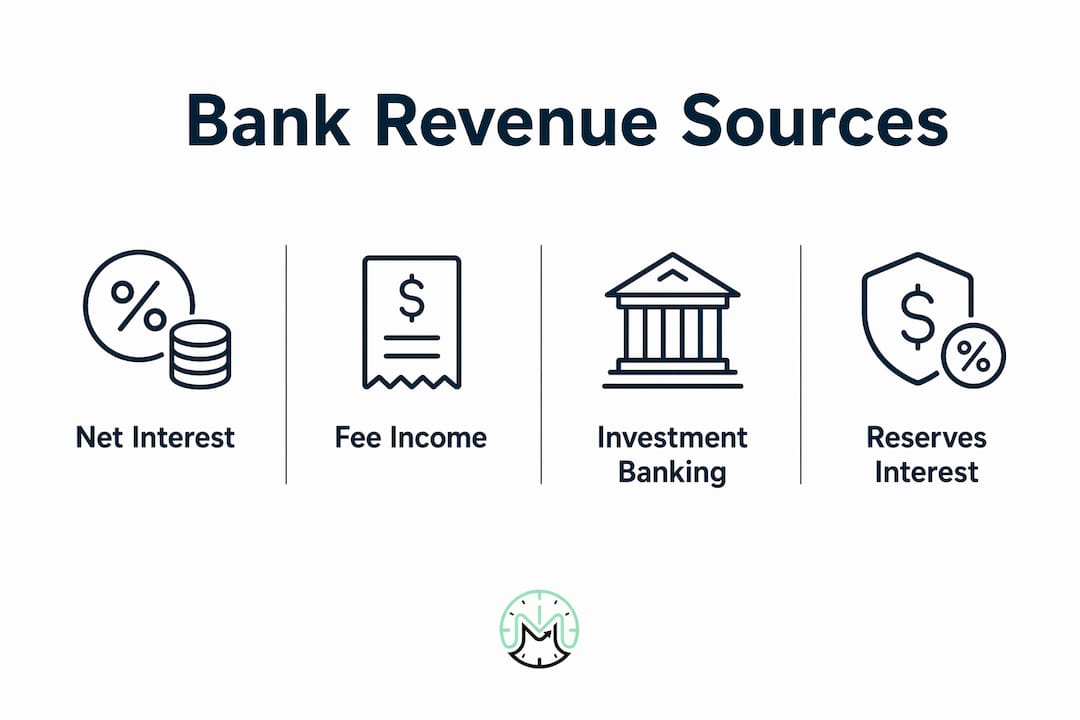
Banks make money primarily by charging more interest on loans than they pay on deposits, a gap called the net interest margin (NIM). This core mechanic, known formally as the spread business, drives 60–75% of total revenue for commercial banks. The remaining revenue comes from fees, investment banking services, and trading income. Understanding how banks generate income gives you real power as a consumer. You can spot where your money goes, negotiate better rates, and make smarter choices about where you bank. Minutementor breaks this down into plain language so you can act on it fast.
How do banks make money through interest?
Net interest income (NII) is the foundation of the banking business model. A bank takes in deposits from customers, paying them a modest interest rate. It then lends that same money out at a higher rate to borrowers. The difference between those two rates is the net interest margin, and it is the engine behind bank profits.
Here is a simple example of how the spread works in practice:
- Your savings account earns 0.50% annual interest.
- The bank lends that money as a mortgage at 7.00% annual interest.
- The bank pockets the 6.50% spread on every dollar lent.
- Multiply that spread across billions of dollars in loans, and the profit becomes enormous.
- Small changes in the spread have outsized effects because banks operate with high leverage, meaning they lend far more than they hold in reserves.
The interest rate environment shapes this margin directly. When the Federal Reserve raises rates, banks can charge more on new loans. However, they often delay raising savings rates for depositors. That delay widens the spread and boosts profits. When rates fall, the margin compresses and earnings shrink.
Net interest margin efficiency is a cornerstone metric analysts use to judge a bank's health. A small improvement in NIM across a large loan portfolio translates into hundreds of millions in additional profit.

Credit cards are one of the most profitable lending products. Banks charge annual percentage rates (APRs) that regularly exceed 20%, while funding those balances at a fraction of that cost. Mortgages and auto loans carry lower rates but generate profit through sheer volume and long repayment terms.
Pro Tip: Traditional banks keep savings rates near zero not just because of overhead costs. Consumer inertia plays a big role. Most people never switch banks, so there is little competitive pressure to pay more. Knowing this, you can negotiate or move your savings to earn more.
How do banks generate fee income and why does it matter?
Fee income is the second major pillar of bank revenue. Non-interest income accounts for roughly 25–40% of total bank revenue. It matters because it does not move with interest rates. When rate spreads compress during economic downturns, fee income provides stability that pure lending income cannot.
The average American household pays $150–$300 per year in bank fees. That figure adds up fast when multiplied across tens of millions of accounts.
Here are the main fee categories banks rely on:
- Overdraft fees: Charged when your account balance goes negative. These fees are typically $25–$35 per occurrence and generate billions annually for large banks.
- Monthly maintenance fees: Flat charges for holding a checking or savings account, often waived only if you meet minimum balance requirements.
- ATM fees: Out-of-network ATM use triggers fees from both your bank and the ATM operator, often totaling $4–$6 per transaction.
- Wire transfer fees: Domestic wires typically cost $15–$30. International wires can run $40–$50 or more.
- Wealth and asset management fees: Banks charge a percentage of assets under management, often 0.50–1.00% annually, for investment advisory services.
Interchange fees are a less visible but massive revenue source. Merchants pay approximately 2–3% of every credit card transaction to the card network and the issuing bank. On a $100 purchase, the bank collects up to $3 with no additional work. This scales to billions of dollars across millions of daily transactions.
Here is the part most people miss: your credit card rewards are not funded by the bank's profits. Rewards programs are financed by interchange fees that merchants pay on every swipe. Merchants effectively subsidize your airline miles and cash back. Banks design rewards programs to increase card usage, which increases interchange revenue.
Pro Tip: You can reduce your fee exposure significantly by choosing accounts with no monthly maintenance fees, using in-network ATMs, and keeping a buffer balance to avoid overdrafts. Learning how banks work at a basic level helps you spot fee traps before they cost you.
What other revenue sources do banks have?
Beyond loans and fees, large banks earn income from investment banking, trading, and central bank reserves. These streams matter most to major institutions like JPMorgan Chase, Goldman Sachs, and Bank of America, but they also explain why big banks are so profitable even when interest margins are thin.
Banks operate two core business models: commercial banking, which focuses on deposits and lending, and investment banking, which provides advisory and capital markets services. Many large institutions run both under one roof.
Investment banking revenue comes from three main activities:
- Advisory fees: Banks charge corporations fees to advise on mergers, acquisitions, and restructurings. A single large deal can generate tens of millions in advisory income.
- Underwriting: When a company issues new stock or bonds, the bank underwrites the offering and earns a percentage of the total amount raised.
- Capital markets trading: Banks buy and sell securities on behalf of clients and sometimes for their own accounts, earning spreads and commissions on each transaction.
Banks also earn interest on reserves they hold at the Federal Reserve. Reserves held at central banks generate interest income that is predictable and low-risk. This became a meaningful revenue line after the Federal Reserve began paying interest on excess reserves. It is not glamorous, but it adds up.
The mix of revenue streams varies by institution. A community bank earns almost entirely from loans and basic fees. A global investment bank earns a large share from capital markets and advisory work. Understanding this difference helps you read bank earnings reports and understand why stock prices move the way they do.
How are online banks changing the traditional revenue model?
Online banks have restructured the traditional banking business model by eliminating the cost of physical branches. A brick-and-mortar bank pays for real estate, tellers, ATMs, and utilities across hundreds or thousands of locations. An online bank pays for servers and customer service staff. That cost difference is significant.
Online banks pass those savings to depositors in the form of higher interest rates on savings accounts. As of early 2026, many online banks offer savings rates around 4.00% APY, compared to rates near 0.01% at many traditional banks. That gap is not a rounding error. On a $10,000 balance, the difference is roughly $399 per year in lost interest if you stay with a low-rate traditional bank.
| Feature | Traditional banks | Online banks |
|---|---|---|
| Savings APY (2026) | Near 0.01% | Around 4.00% |
| Branch access | Extensive | None or limited |
| Monthly fees | Common | Often waived |
| ATM network | Proprietary | Reimbursed or partnered |
| Overhead costs | High | Low |
Traditional banks compete by offering convenience, relationship banking, and bundled services like mortgages and business accounts. Online banks compete on price. The right choice depends on what you value more. If you rarely visit a branch and want to grow your savings faster, an online bank wins on pure math. If you need in-person service or a full suite of financial products, a traditional bank may still make sense.
The rise of online banking also pressures traditional banks to raise their own savings rates, at least for customers who ask. Knowing the balance between saving and borrowing helps you take full advantage of this competitive shift.
Minutementor makes banking easy to understand
Understanding how banks profit is the first step to making your money work harder for you. Minutementor delivers exactly this kind of financial education in five-minute daily lessons built around your goals.

Whether you want to build better savings habits, understand interest rates, or figure out how to stop paying unnecessary fees, Minutementor's AI-powered finance coach creates a learning path tailored to where you are right now. You get interactive lessons, progress tracking, and a format you can finish on your commute. Visit Minutementor and start building real financial knowledge today. No jargon, no fluff, just the skills that actually move the needle on your money.
FAQ
How do banks make money on savings accounts?
Banks pay depositors a low interest rate on savings accounts, then lend that money out at a much higher rate. The difference between those two rates is the net interest margin, which is the primary source of bank profit.
What fees do banks charge to make money?
Banks charge overdraft fees, monthly maintenance fees, ATM fees, wire transfer fees, and interchange fees on card transactions. The average American household pays $150–$300 per year in bank fees.
What is net interest margin?
Net interest margin (NIM) is the difference between the interest a bank earns on loans and the interest it pays on deposits, expressed as a percentage of earning assets. It is the core profitability metric for commercial banks.
Do online banks make money the same way?
Online banks still earn money through interest spreads and fees, but their lower overhead lets them pay depositors higher rates. This narrows their margin per account but attracts more deposits through competitive pricing.
How does investment banking generate revenue?
Investment banks earn fees from advising on mergers and acquisitions, underwriting stock and bond offerings, and trading securities. These revenue streams are separate from traditional deposit and lending income.
Key takeaways
Banks generate profit through three main channels: the net interest margin, fee income, and investment banking services. Knowing which channel costs you the most gives you the power to reduce it.
| Point | Details |
|---|---|
| Net interest margin drives most profit | NII represents 60–75% of commercial bank revenue by capturing the spread between loan and deposit rates. |
| Fee income adds stability | Non-interest fees account for 25–40% of revenue and hold steady even when interest rate spreads shrink. |
| Interchange fees fund your rewards | Credit card rewards are financed by the 2–3% merchants pay on every card transaction, not by bank profits. |
| Online banks offer better savings rates | Online banks pay around 4.00% APY in 2026 versus near 0.01% at many traditional banks due to lower overhead. |
| Consumer inertia costs you money | Traditional banks keep savings rates low because most customers never switch. Shopping around pays off. |