A financial literacy skills checklist is a structured tool that maps the core money management skills every person needs to build financial security. Whether you are a high school student opening your first bank account, a young professional juggling student loans, or a parent teaching your kids about money, this checklist gives you a clear picture of where you stand and what to work on next. Budgeting apps, credit score monitoring tools, and savings trackers all improve engagement and help you maintain real progress. Fidelity and FINRA both confirm that personal mastery of money skills is now critical for long-term security, especially as employer pensions have become rare.
1. What does a financial literacy skills checklist actually cover?
A financial literacy skills checklist covers five core areas: budgeting, saving, debt management, income stability, and money mindset. These five pillars give you a complete picture of your financial health, not just one slice of it. Skipping any one area creates blind spots. A person who saves well but ignores debt, for example, may be losing more to interest than they are gaining in a savings account.
The five areas break down like this:
- Budgeting: Creating a spending plan, tracking expenses monthly, and adjusting categories when life changes
- Saving: Setting short and long-term goals, building an emergency fund, and automating transfers
- Debt management: Understanding interest rates, prioritizing high-cost debt, and avoiding new debt traps
- Income and cash flow: Knowing your net income, managing irregular income, and planning for taxes
- Money mindset: Recognizing spending triggers, building discipline, and staying consistent over time
Each category contains specific skills you can check off as you build them. That is what separates a checklist from a vague goal like "get better with money." You get a concrete list of abilities to develop, one at a time.
2. What are the essential financial literacy skills everyone should master?

The most foundational money management skill is knowing exactly where your money goes each month. Without that baseline, every other financial decision is a guess. Expense tracking is the starting point for any personal finance checklist, and it takes less than 10 minutes a day when done consistently.
Beyond tracking, here are the skills that form the core of any financial skills assessment:
- Create and stick to a budget: Choose a method that fits your personality. The 50/30/20 rule (50% needs, 30% wants, 20% savings and debt) works for many beginners. Zero-based budgeting suits people who want full control over every dollar.
- Build an emergency fund: Start with a $1,000 target, then grow to three to six months of expenses. This single habit lays the foundation for every other financial goal.
- Understand credit scores: Know what affects your score, including payment history, credit utilization, and account age. A score above 700 opens doors to lower interest rates on loans and credit cards.
- Manage debt strategically: List every debt by interest rate. Pay minimums on all, then throw extra money at the highest-rate debt first. This is the avalanche method, and it saves the most money over time.
- Start investing early: Even $25 a month in a low-cost index fund compounds significantly over decades. The earlier you start, the less you need to invest overall.
- Read a pay stub and a tax return: Most adults cannot explain what FICA means or why their refund changed. Understanding your income documents is a basic financial skill that affects every other decision.
- Set written financial goals: Goals without a deadline and a dollar amount are just wishes. Writing them down and reviewing them monthly is a proven habit among people who build wealth consistently.
Pro Tip: Budgeting success depends more on behavioral alignment with your personality than on math skills. If you hate spreadsheets, a budgeting app like YNAB or Mint will work better for you than a manual system.
3. How can you assess your current financial literacy?
The fastest way to assess your financial literacy is a structured self-scoring tool. Bmoneyed's financial health score calculator covers five core areas across 10 questions and takes about 60 seconds to complete. Each category scores on a 0–100 scale, so you immediately see which areas are strong and which need work. That specificity matters. Knowing you scored low on "money mindset" is more useful than knowing you "need to improve."
For a deeper assessment, the Paradigm Education Financial Literacy Inventory (FLI) Second Edition is a 60-item standardized inventory covering income, banking, credit, and investing. It takes about 20 minutes and produces both an overall benchmark score and individual scores across five scales. Teachers, counselors, and financial coaches use it to create personalized improvement plans.
Here is a simple self-assessment framework you can use right now:
- Rate your budgeting: Do you know your exact monthly expenses? Score yourself 1 (no idea) to 5 (tracked to the dollar).
- Rate your saving: Do you have an emergency fund? Score 1 (nothing saved) to 5 (six months of expenses saved).
- Rate your debt knowledge: Do you know the interest rate on every debt you carry? Score 1 (no idea) to 5 (yes, and I have a payoff plan).
- Rate your investing knowledge: Can you explain what an ETF is and why diversification matters? Score 1 (never invested) to 5 (actively managing a portfolio).
- Rate your money mindset: Do you make impulse purchases regularly? Score 1 (frequently) to 5 (rarely, with a clear plan).
| Score range | What it means | Recommended next step |
|---|---|---|
| 5–10 | Building the basics | Focus on budgeting and tracking first |
| 11–16 | Developing skills | Add saving goals and debt payoff plan |
| 17–21 | Intermediate | Start investing and automate savings |
| 22–25 | Advanced | Refine strategy and teach others |
Retake this assessment every three months. Progress is motivating, and seeing your score climb keeps you consistent.
4. Key actions to build your money management skills step by step
Building financial literacy is not a one-week project. Mastering cash flow management takes 1–3 months. Building an emergency fund takes 3–12 months. Wealth building is ongoing. Knowing this upfront prevents the frustration of expecting fast results.
Here is a practical, staged action plan:
- Month 1: Track everything. Use a free app or a notebook. Record every purchase for 30 days without judging yourself. The goal is awareness, not perfection. Most people discover at least one spending category that surprises them.
- Month 1–2: Build your first budget. Take your tracked data and create a spending plan for next month. Assign every dollar a job. If you overspend in a category, adjust the next month rather than quitting.
- Month 2–3: Start your emergency fund. Open a separate high-yield savings account. Set up an automatic transfer of even $25 per paycheck. The amount matters less than the habit. Fidelity's planning framework confirms that starting small with tracking and a $1,000 emergency fund is the right foundation regardless of income.
- Month 3–6: Attack high-interest debt. List every debt. Rank by interest rate. Pay the minimum on everything except the highest-rate debt, and put every extra dollar there. A $3,000 credit card balance at 22% costs you roughly $660 per year in interest alone.
- Month 6 and beyond: Start investing. Open a Roth IRA or contribute to your employer's 401(k) up to the match. A low-cost index fund from Vanguard, Fidelity, or Schwab gives you instant diversification at minimal cost.
- Ongoing: Automate everything you can. Automation is the backbone of sustainable financial literacy. Auto-transfers to savings, auto-payments on bills, and automatic investment contributions remove the daily willpower requirement. You build wealth by default, not by discipline alone.
Pro Tip: Set a monthly "money date" with yourself. Spend 20 minutes reviewing your budget, checking your savings progress, and confirming your debt balances. Consistency beats intensity every time.
One common challenge is staying motivated when progress feels slow. Tracking net worth monthly, even when the number is negative, shows directional progress. Going from negative $15,000 to negative $12,000 is real progress worth celebrating.
5. How financial literacy skills differ across life stages
A 16-year-old learning to budget a part-time paycheck needs different tools than a 35-year-old parent managing a mortgage and a college savings plan. A good budgeting skills checklist adapts to your life stage. The core skills are the same, but the priorities and complexity shift significantly.
| Life stage | Priority skills | Key checklist items |
|---|---|---|
| High school (ages 14–18) | Earning, saving, basic banking | Open a checking account, save 20% of income, avoid impulse spending |
| College (ages 18–22) | Budgeting, student loans, credit | Track expenses weekly, understand loan terms, build credit responsibly |
| Young professional (ages 22–35) | Debt payoff, investing, insurance | Pay off student loans, max employer 401(k) match, build six-month emergency fund |
| Parent (any age) | Teaching kids, college savings, protection | Open a 529 plan, model good money habits, review life insurance coverage |
For teens, smart money habits start with understanding the difference between needs and wants, then progress to saving a fixed percentage of every paycheck. The habit of saving before spending is easier to build at 16 than at 30.
For parents, the most effective financial education strategy is modeling behavior, not just lecturing. Kids who watch parents budget, save, and discuss money openly develop stronger financial instincts. Teaching money skills early greatly improves practical literacy outcomes across all age groups. Starting conversations about money at age five or six, using concepts like saving for a toy, builds the mental framework that supports adult financial decisions later.
Young professionals face a specific challenge: competing financial priorities. Student loans, rent, retirement savings, and an emergency fund all demand attention at once. The right sequence matters. Prioritize the employer 401(k) match first (it is free money), then build the emergency fund, then attack student loan debt above 6% interest.
For age-specific financial lessons, the complexity of concepts should match the child's developmental stage. A 10-year-old can understand opportunity cost. A 14-year-old can understand compound interest with a simple calculator exercise. A 17-year-old can open a custodial brokerage account and watch real investments grow.
Build your financial skills faster with Minutementor
Minutementor delivers targeted financial education through five-minute daily lessons designed for people who are busy but serious about building real money skills.
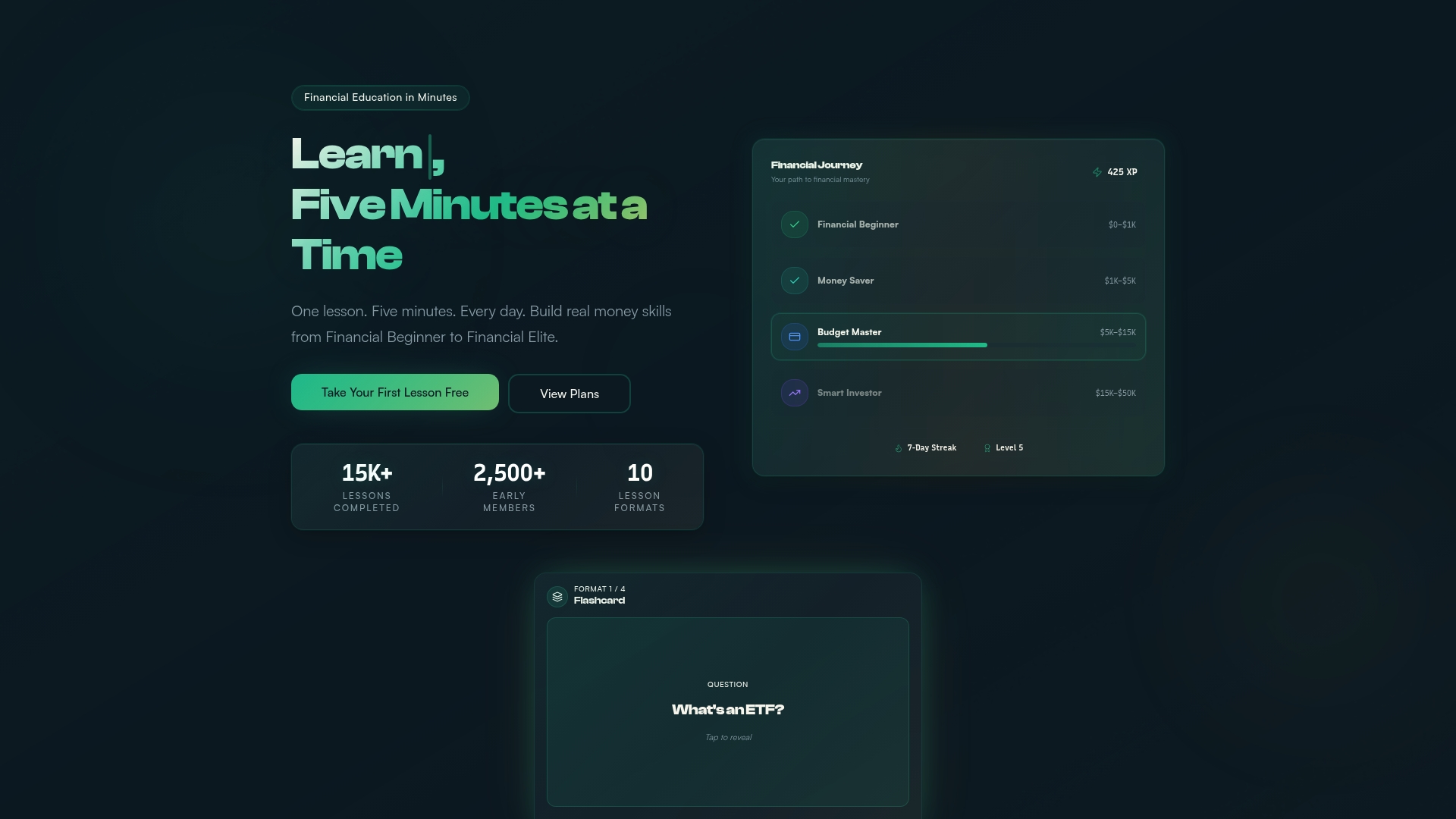
The platform's AI-powered personal finance coach builds a learning path around your specific goals, whether that is paying off debt, building savings, or starting to invest. You get interactive lessons, progress tracking, and a gamified system that keeps you coming back. Students have used Minutementor to save thousands and hit financial milestones they thought were years away. Start building your skills today and see how much ground you can cover in just five minutes a day. You can also explore practical budgeting tips and strategies to complement your learning path.
Key takeaways
A financial literacy skills checklist works because it breaks money mastery into specific, trackable skills across budgeting, saving, debt, investing, and mindset.
| Point | Details |
|---|---|
| Start with a self-assessment | Use a quick scoring tool to identify your weakest financial skill area before taking action. |
| Follow a staged action plan | Build budgeting and emergency savings first, then tackle debt, then invest. |
| Match skills to your life stage | Teens, young professionals, and parents each need a different checklist focus. |
| Automate to stay consistent | Auto-transfers and auto-payments remove reliance on daily motivation. |
| Reassess every three months | Periodic scoring shows real progress and keeps your financial education moving forward. |
FAQ
What is a financial literacy skills checklist?
A financial literacy skills checklist is a structured list of money management skills organized by category, such as budgeting, saving, and investing, that helps you assess your current knowledge and track improvement over time.
How long does it take to become financially literate?
Core skills like budgeting and cash flow management typically take 1–3 months to develop. Building an emergency fund takes 3–12 months, and wealth-building skills develop over years of consistent practice.
What is the best way to assess my financial literacy?
A quick tool like Bmoneyed's 60-second financial health score calculator gives you an immediate snapshot across five categories. For a deeper assessment, the Paradigm Education Financial Literacy Inventory covers 60 items across income, banking, credit, and investing.
At what age should financial education start?
Financial education should start early, with simple concepts like saving for a goal introduced as early as age five or six. Early financial education produces stronger money habits in adulthood.
What is the single most important financial skill to build first?
Expense tracking is the most important first skill. You cannot budget, save, or pay down debt effectively without knowing exactly where your money goes each month.