The role of chores in money lessons is to give children their first real experience with earning, saving, and making choices about money. Household tasks create a direct link between effort and reward that no classroom exercise can replicate. Research from the AICPA and parenting experts like Julie Lythcott-Haims confirms that chores build life skills that extend well beyond tidying a bedroom. Apps like Greenlight show that parents are actively looking for structured ways to connect chores and financial literacy at home. This guide gives you a research-backed system to make it work.
What is the role of chores in money lessons for kids?
Chores are the most practical tool parents have for teaching financial responsibility. They create a direct, physical experience of the connection between work and money. That experience is what makes the lesson stick.
The core concept here is earned income, a term financial educators use to describe money received in exchange for work. When your child washes dishes and receives an allowance, they are practicing the same principle that governs every paycheck they will ever earn. Chores teach children that money is tied to effort, integrity, and character, not just the end result.

Chores also teach delayed gratification. A child who saves three weeks of allowance to buy a toy has practiced budgeting in the most concrete way possible. That skill transfers directly to adult behaviors like building an emergency fund or avoiding impulse purchases.
The importance of chores in finance goes beyond the dollar amount. The habits formed early, specifically the habit of working before spending, shape how children relate to money for the rest of their lives. Financial skills from chores are built through repetition, not a single lesson.
How do chores teach kids the value of work and money?
Chores show children that money represents exchanged effort. That lesson is harder to teach with words alone. When a child scrubs a bathroom and then holds the dollar they earned, the connection is immediate and real.
The overjustification effect is a key concept parents should understand. A 1973 psychology study found that adding extrinsic rewards (like money) to tasks children already find satisfying can actually reduce their long-term interest in those tasks. This matters because some chores, like helping cook dinner, may already feel rewarding to a child. Paying for every single task risks turning natural helpfulness into a transaction.
The solution is to separate chores that reflect family membership from chores that represent extra earning opportunities. Picking up toys is a family duty. Washing the car on Saturday is a paid gig. That distinction preserves both intrinsic motivation and the money lesson.
Work discipline is another benefit. A child who commits to taking out the trash every Tuesday, regardless of mood, is practicing the same reliability that employers value. Julie Lythcott-Haims, former Stanford dean and author of How to Raise an Adult, found that children who do regular chores develop stronger interpersonal relationships, higher self-reliance, and greater professional success.
- Chores build time management by requiring tasks to be done on a schedule.
- They build confidence when children see that their contribution matters.
- They teach integrity when kids complete tasks even without supervision.
- They create natural openings for conversations about money and saving.
Pro Tip: Praise the effort and the follow-through, not just the finished task. Saying "I noticed you did that without being asked" builds the intrinsic motivation that makes money lessons last.
Which allowance model works best for teaching money management?
Three main allowance models exist, and each one teaches a different lesson. Choosing the right one depends on your child's age, your family values, and what financial skill you want to build first.
| Model | How it works | Key benefit | Key risk |
|---|---|---|---|
| Unconditional allowance | Fixed amount given regardless of chores | Teaches money management without pressure | May miss the work-to-income connection |
| Chores-for-pay | Every chore has a dollar value; no work, no pay | Directly links effort to income | Can create a transactional mindset; risks overjustification |
| Hybrid model | Base allowance plus optional paid chores | Balances family duty with earning opportunity | Requires consistent parent follow-through |
A 2019 AICPA survey found that 52% of parents believe allowance should be earned entirely through chores, 27% use a mixed model, and 20% give a no-strings allowance. The majority of parents instinctively tie money to work, but the research suggests the hybrid approach produces the best outcomes.
Financial educators recommend the hybrid model because it separates household contribution from income earning. The base allowance gives children consistent money to practice budgeting. The optional paid chores give them a way to earn more by choosing to work harder. That mirrors how adult financial life actually works.
For children under 8, avoid tying allowance strictly to chores. The overjustification effect is strongest in younger children, and introducing payment too early can reduce the natural motivation to help. A small, consistent base allowance works better at this stage.
Consistent, smaller allowances teach more effectively than irregular, larger sums. Predictable money builds predictable habits. That regularity is the foundation of every budgeting skill your child will develop.
Age-appropriate chores that build real financial skills
Matching chore complexity to your child's age makes the money lesson more effective. A task that is too easy teaches nothing. A task that is too hard creates frustration instead of confidence.
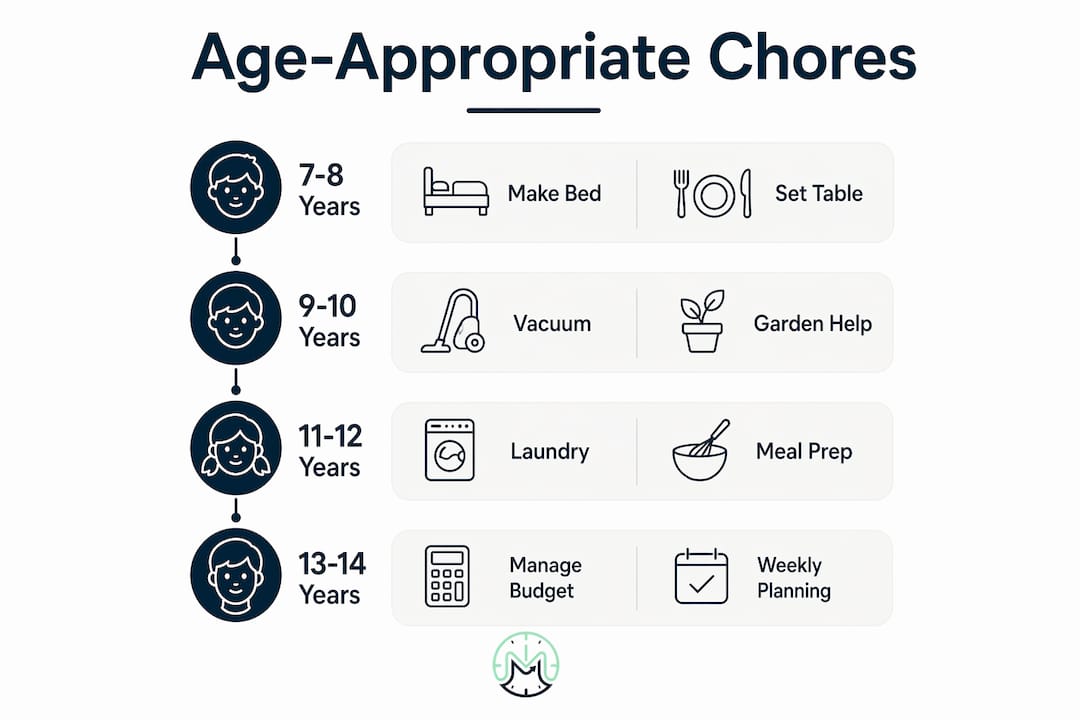
Pediatric guidance updated in 2026 provides a clear framework for age-appropriate chore assignments.
| Age group | Example chores | Money skill practiced |
|---|---|---|
| 7–8 years | Making bed, setting the table, feeding pets | Responsibility, routine, earning basics |
| 9–11 years | Vacuuming, loading dishwasher, folding laundry | Consistency, task completion, saving goals |
| 12–13 years | Cleaning bathrooms, mowing lawn, grocery help | Budgeting, effort-to-reward ratio |
| 14–18 years | Cooking meals, yard work, car washing | Work ethic, financial planning, delayed gratification |
The progression matters. A 10-year-old who vacuums weekly and saves toward a video game is practicing the same budgeting cycle as a teenager saving for a car. Each stage builds on the last.
Age-appropriate money lessons work best when the chore connects to a visible financial goal. Ask your child what they are saving for before assigning paid tasks. That goal becomes the motivation that makes the lesson real.
A few practical tips for matching chores to age:
- Start with one or two paid chores at a time to avoid overwhelm.
- Let older teens negotiate the pay rate for extra tasks. That is a negotiation skill with direct financial value.
- Revisit chore assignments every six months as your child grows.
- Connect chore earnings to a three-jar system: spend, save, and give.
Pro Tip: Use a physical jar or a kids' banking app like Greenlight to make the money visible. Children learn faster when they can see their savings grow in real time.
How to build a chore and allowance system that actually teaches money
A well-designed system avoids the two biggest mistakes parents make: using money as punishment and failing to explain the purpose behind the rules.
Follow these steps to build a system that works:
-
Define family chores separately from paid chores. Separating unpaid duties from paid tasks prevents entitlement and teaches children that some contributions are simply part of belonging to a family.
-
Never withhold allowance as punishment. Using money as punishment harms financial independence. It teaches children to associate money with fear rather than effort and choice.
-
Explain the purpose of every rule. Parents should explain the why behind each task and earning. A child who understands that saving half their allowance builds toward a bigger goal is more motivated than one who follows a rule without context.
-
Have regular money conversations. Talking about spending, saving, and giving earned allowance deepens the lesson far beyond the chore itself. Ask your child what they plan to do with their money this week.
-
Stay consistent. Pay on the same day every week. Consistency builds the habit of expecting and managing regular income, which is exactly how adult budgeting works.
-
Reward effort and integrity, not just completion. A child who tells you they forgot a chore and offers to make it up is demonstrating exactly the character that financial responsibility requires. Recognize that behavior out loud.
The best chore and allowance systems focus on effort and lessons, not just task completion and payment. The goal is not a clean house. The goal is a child who understands how money works and feels confident managing it. For teens ready to build on these habits, smart money habits for high school students offer the next level of financial skill-building.
Minutementor makes money lessons easy for parents
Teaching kids about money through chores is powerful. Keeping that learning consistent over months and years is where most parents need support.

Minutementor is built for exactly this. The platform delivers five-minute daily money lessons designed for kids and young learners, with an AI-powered coach that adjusts the content to match your child's current goals, whether that is budgeting their allowance, understanding saving, or building toward a first financial milestone. Progress tracking and gamified lessons keep kids engaged without turning learning into a chore of its own. Start building financial skills with Minutementor and give your child a structured path from their first earned dollar to confident money management. Check out Minutementor's pricing to find the right plan for your family.
Key takeaways
Chores teach financial responsibility most effectively when paired with a hybrid allowance model, age-appropriate task assignments, and consistent money conversations at home.
| Point | Details |
|---|---|
| Hybrid model wins | Combine a base allowance with optional paid chores to balance family duty and earning lessons. |
| Age matters | Match chore complexity to your child's development stage to build the right money skills at the right time. |
| Separate duties from paid tasks | Keep family chores unpaid to prevent entitlement and preserve intrinsic motivation. |
| Never use money as punishment | Withholding allowance teaches fear, not financial responsibility. |
| Conversations multiply the lesson | Talking about spending, saving, and giving earned money deepens every financial skill chores build. |
FAQ
What is the best age to start chores for money lessons?
Children as young as 7–8 can begin simple chores tied to a small allowance. Start with a base allowance and introduce optional paid tasks gradually as they grow.
Should allowance always be tied to chores?
Not entirely. Financial educators recommend a hybrid model where a base allowance is given unconditionally and extra chores provide additional earning opportunities. This balances money practice with work ethic.
How do chores and financial literacy connect?
Chores create a hands-on experience of earned income, budgeting, and delayed gratification. These are the same core skills that define financial literacy in adults.
Can paying kids for chores backfire?
Yes. The overjustification effect shows that paying children for tasks they already enjoy can reduce their natural motivation over time. Reserve paid chores for tasks beyond basic family responsibilities.
How much allowance should I give per chore?
No universal rate exists, but financial educators suggest tying the amount to the child's age and the effort required. Consistency in payment schedule matters more than the exact dollar amount.