To balance loan repayment and saving means building financial security on two fronts at once, without letting either goal collapse the other. Most borrowers treat this as an either/or choice. That framing costs them. The smarter approach is sequencing: build a liquidity floor first, then direct surplus cash based on your loan's interest rate versus what you could realistically earn elsewhere. This guide gives you a research-backed framework for managing debt and savings together, covering emergency funds, federal repayment options, investment decisions, and the automation habits that make it stick.
Why build an emergency fund before extra loan payments?
An emergency fund is your financial defense system. Without one, a single unexpected expense forces you onto credit cards or into loan forbearance, both of which cost far more than any interest you saved by prepaying your student loan.
Fidelity recommends saving at least $1,000 as a starter milestone, then building toward 3–6 months of essential expenses. That range exists because job loss, medical bills, and car repairs rarely give you advance notice. Hitting $1,000 first gives you a real buffer without requiring months of sacrifice before you feel progress.

Where you park this money matters. High-yield savings accounts in 2026 are yielding roughly 3.75%–4.25% APY. That means your emergency fund is not just sitting idle. It is growing while staying fully accessible, which is exactly what you need from a liquidity reserve.
Here is why skipping this step backfires:
- Missed payments trigger interest capitalization. When interest capitalizes, it gets added to your principal, and you start paying interest on interest. Cash buffers prevent this harmful cycle during forbearance or payment gaps.
- Credit card debt at 14%–25% APR wipes out any gains from extra loan payments you made before building your buffer.
- Raiding retirement accounts to cover emergencies triggers taxes and penalties that set you back years.
Emergency savings prevent setbacks from turning into costly new borrowing and reduce the chance of pulling from long-term investments at the worst possible time.
Pro Tip: Start with a $1,000 emergency fund goal before you send a single extra dollar to your loan servicer. Once you hit that milestone, split new surplus between building the fund toward 3 months of expenses and accelerating your loan payments.
Should you pay extra on loans or invest your surplus?
This is the question most borrowers get wrong, and they get it wrong because they answer it emotionally. The real decision should be based on your loan's APR versus your realistic after-tax investment return, not on how debt makes you feel.
Here is the logic in plain terms:
- Calculate your loan APR. Every extra dollar you pay toward a 7% loan earns you a guaranteed 7% return. No market risk, no volatility.
- Estimate your after-tax investment return. Use conservative figures. Historical stock market averages run around 10% pre-tax, but after taxes and fees, a realistic long-term expectation is closer to 6%–7% for most investors.
- Compare the two numbers. If your loan APR exceeds your after-tax expected return, pay down the loan first. If your expected return is higher, invest the surplus.
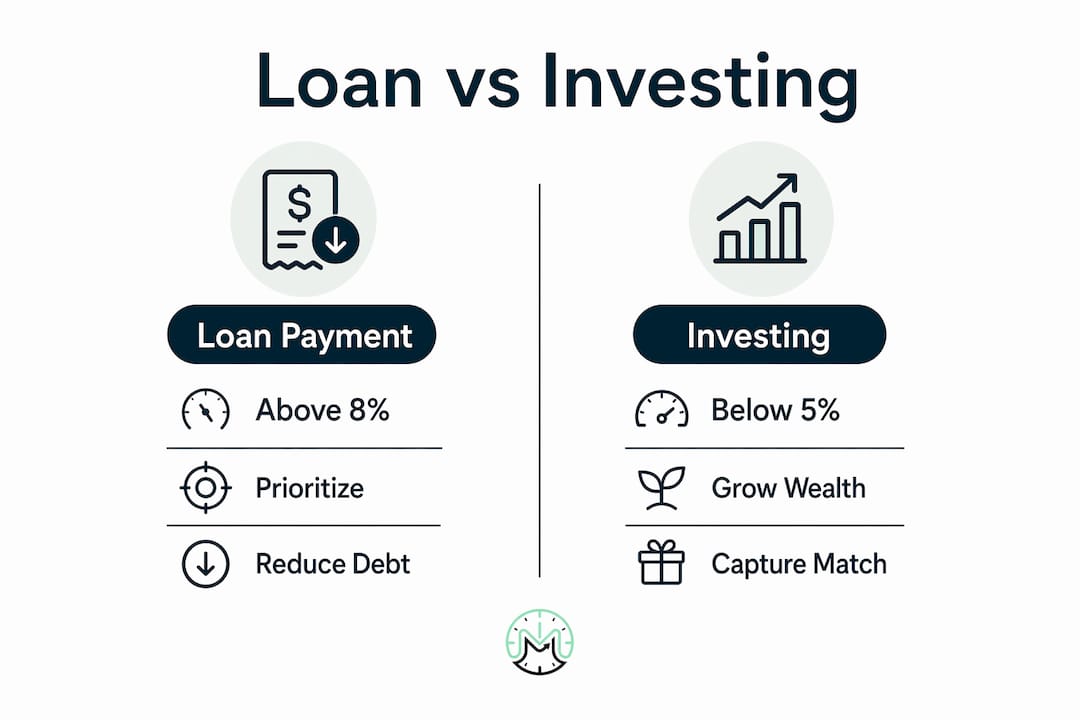
- Apply the threshold rule. Loans above 6%–8% APR generally favor prepayment. Loans below that range often favor investing, especially in tax-advantaged accounts like a Roth IRA or 401(k).
- Stress-test your cash flow. Before committing to any accelerated payment plan, confirm you can sustain it through a job loss or income dip without missing required minimums.
One exception overrides this entire framework: your employer's 401(k) match. Capturing the employer match delivers an immediate 50%–100% return on your contribution, which no loan prepayment can compete with. Always capture the full match before directing extra cash anywhere else.
| Scenario | Best Move |
|---|---|
| Loan APR above 8% | Prioritize extra loan payments |
| Loan APR below 5% | Invest in tax-advantaged accounts |
| Employer 401(k) match available | Capture full match first, always |
| APR between 5%–8% | Use a hybrid split strategy |
Pro Tip: A hybrid approach splitting extra cash 50/50 between loan prepayment and investing keeps momentum on both fronts. You reduce debt faster than minimum payments while still building investment growth.
How do federal IDR plans affect your saving strategy?
Federal student loan borrowers have a tool that private loan holders do not: income-driven repayment, or IDR. IDR plans cap your monthly payment as a percentage of your discretionary income and offer loan forgiveness after 20–25 years, depending on the plan.
The plans currently available include SAVE (Saving on a Valuable Education), PAYE (Pay As You Earn), and IBR (Income-Based Repayment). Each calculates your payment differently, but all share the same core benefit: lower required payments that free up cash for saving and investing.
Here is what this means for your repayment strategy:
- Extra payments above your IDR minimum can be counterproductive. If you are pursuing forgiveness, every extra dollar you pay reduces the balance that eventually gets forgiven. You are essentially paying off debt that the government would have canceled.
- Keeping payments at the required minimum under IDR lets you redirect surplus cash to your emergency fund, retirement accounts, and other savings goals.
- Public Service Loan Forgiveness (PSLF) accelerates the timeline to 10 years for qualifying public sector and nonprofit employees. If you qualify, minimizing extra payments is mathematically optimal.
- Recertify your income annually. IDR payments adjust based on your reported income. Recertifying on time keeps your payment accurate and your forgiveness timeline intact.
The key insight here is that lower payments improve affordability and reduce default risk, but they increase total interest paid over time. If you are not pursuing forgiveness, IDR is a cash flow tool, not a long-term cost saver. Use it to protect liquidity, not to avoid paying down your balance.
How to build saving habits while paying off loans
Saving while paying loans is not about finding a magic budget number. It is about building systems that remove the decision from your hands entirely.
Start with retirement. Capturing your employer's 401(k) match is a non-negotiable first step. A 50% match on your contribution is a guaranteed return no savings account or loan prepayment can beat. If your employer matches up to 4% of your salary, contribute at least 4% before allocating anything else.
From there, build your savings structure around these priorities:
- Emergency fund first. Comerica recommends starting with a $1,000 buffer and reviewing your budget every 3–6 months to increase it as your income grows.
- Automate everything. Setting up autopay on your loans can earn you a 0.25% interest rate discount while eliminating the risk of missed payments and late fees. Automate savings transfers on payday so the money moves before you can spend it.
- Use the 50/30/20 rule as a starting point. Allocate 50% of take-home pay to needs, 30% to wants, and 20% to savings and debt above minimums. Adjust the 20% bucket based on your APR versus investment return analysis.
- Track expenses to find hidden surplus. Most borrowers have $100–$300 per month in subscriptions and discretionary spending they do not notice. Tracking your expenses surfaces that money and lets you redirect it intentionally.
For young professionals looking to build this habit fast, automating investments early compounds the benefit. Time in the market matters more than timing the market, especially when you are also carrying low-interest student debt.
Pro Tip: Treat your savings transfer like a bill payment. Schedule it for the same day your paycheck lands. You will adjust your spending to whatever is left, not the other way around.
Gradual progress beats perfection here. Start by saving just 1% of your income alongside loan payments. Increase it by 1% every three months. By the end of a year, you are saving 4% more than you were without ever feeling a dramatic cut.
Key takeaways
The most effective way to manage debt and savings simultaneously is to sequence your priorities: build a liquidity floor first, capture guaranteed returns like employer matches, then allocate surplus based on your loan APR versus realistic after-tax investment returns.
| Point | Details |
|---|---|
| Emergency fund comes first | Build a $1,000 starter fund before making any extra loan payments. |
| Match beats everything | Always capture your full employer 401(k) match before directing extra cash elsewhere. |
| APR is your decision rule | Pay extra on loans above 6%–8% APR; invest surplus when your after-tax return exceeds the loan rate. |
| IDR changes the math | Federal IDR borrowers pursuing forgiveness should minimize extra payments to maximize the forgiven balance. |
| Automate to stay consistent | Autopay on loans and scheduled savings transfers remove willpower from the equation entirely. |
Build your money skills with Minutementor
You now have the framework. The next step is building the daily habits that make it automatic.
Minutementor delivers five-minute daily lessons on budgeting, debt management, and investing, designed specifically for students and young professionals who want real skills without the overwhelm. The AI-powered coach builds a personalized learning path around your goals, whether that is paying off loans faster, building an emergency fund, or starting to invest. You can finish a lesson on your commute and actually apply it the same day. Start your free learning path at Minutementor and level up your money game one lesson at a time.
FAQ
What does it mean to balance loan repayment and saving?
Balancing loan repayment and saving means meeting your required loan payments while simultaneously building an emergency fund and contributing to savings or investment accounts. The goal is financial progress on both fronts without sacrificing liquidity.
Should i pay off student loans or save money first?
Build a $1,000 emergency fund first, then capture any employer 401(k) match, then direct extra cash based on your loan's APR versus expected after-tax investment returns. Loans above 6%–8% APR generally favor prepayment over investing.
How do income-driven repayment plans help with saving?
IDR plans lower your required monthly payment to a percentage of your income, freeing up cash for savings. Borrowers pursuing forgiveness should avoid extra payments, since the remaining balance gets canceled after 20–25 years.
What is the best account for an emergency fund?
A high-yield savings account is the best option for an emergency fund. In 2026, top accounts yield 3.75%–4.25% APY, giving your buffer meaningful growth while keeping the money fully accessible.
How often should i review my loan and savings plan?
Review your repayment and savings plan every 3–6 months, or whenever your income or expenses change significantly. Regular check-ins let you adjust payment amounts and savings rates to match your current financial situation.